Trademark Registered in Your Personal Name? How Can You Transfer It to Your Company?
27 November 2026
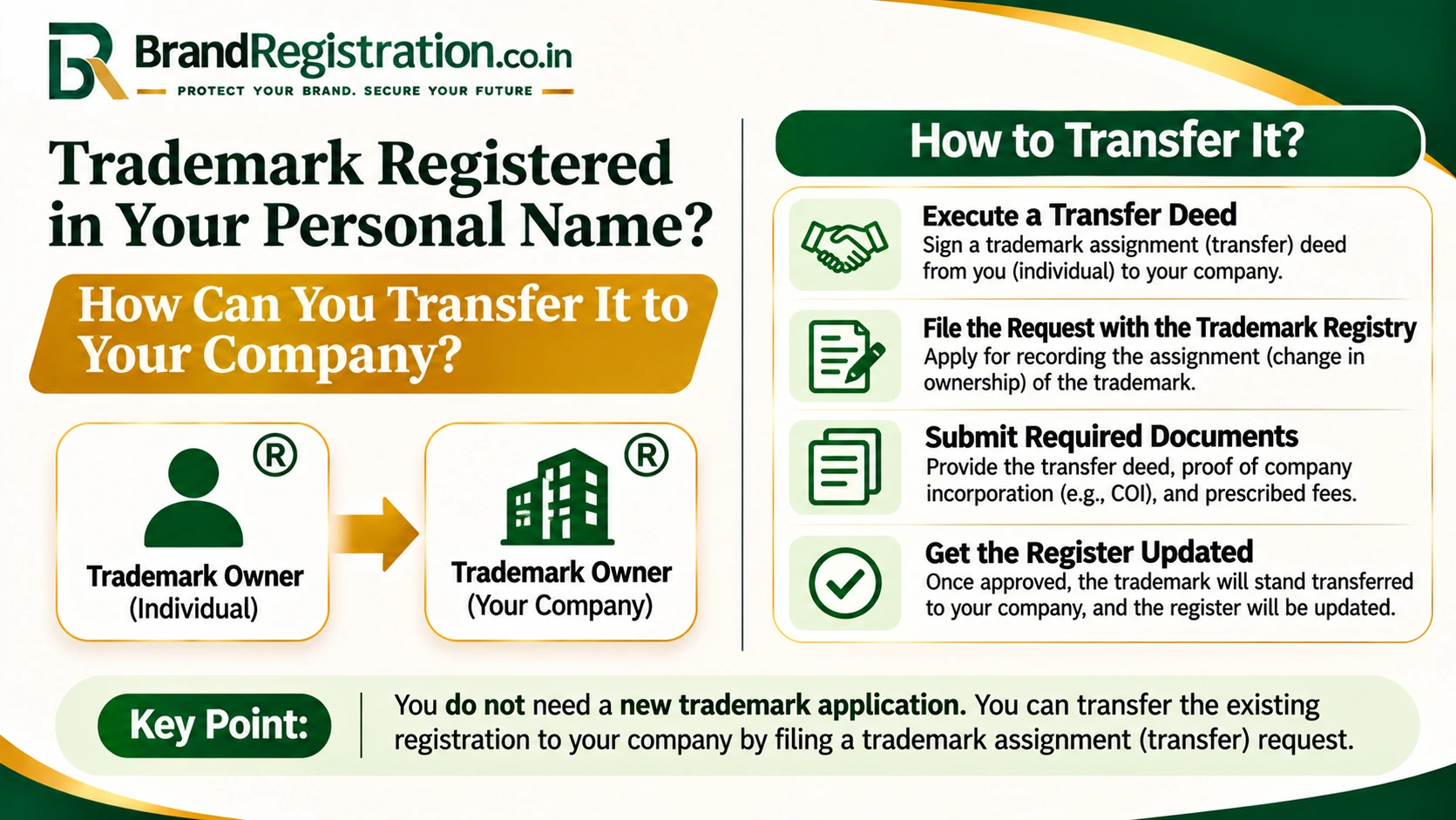
Table of Contents
You can transfer a trademark from an individual to a company through a written assignment and apply to record the company as the subsequent proprietor. Budget separately for the transaction, applicable government charges, stamp duty and any professional work: the total depends on the marks and rights involved.
A trademark registered in your personal name does not move to your company merely because you incorporate it. Before asking for a quote, identify exactly what the company should own and whether the price covers only filing or the work needed to complete the transfer.
1. How to transfer trademark from individual to company: 1 asset, 2 legal owners
An assignment is a transfer of ownership. The individual is the assignor, and the company receiving the mark is the assignee. Section 45 of the Trade Marks Act, 1999 provides for registration of title when a person becomes entitled to a registered trademark by assignment or transmission.
The distinction matters even if you founded the company, control its bank account and have always used the brand in the business. The company and the individual are separate legal persons. A company using a founder-owned mark is not, for that reason alone, the registered owner.
1.1 Ownership versus permission
Assignment is useful when the company should hold the trademark as its own asset. A licence serves a different purpose: it can give the company permission to use the mark while ownership remains with the individual. The choice affects who controls the asset and what happens if the founder and company later part ways.
For example, a founder who intends to retain the brand for several independent ventures may prefer to consider a licence. A founder who wants the operating company to own the brand for a future business sale may instead prefer assignment. The commercial arrangement should be settled before drafting either document.
1.2 Who can use this route?
The starting point is an identifiable owner with title to the mark and a receiving entity capable of holding it. The individual named on the register may be the founder, a creative professional or a sole proprietor. The company should already exist as a legal entity when it is identified as the recipient.
A trademark transfer from proprietorship to company needs particular care because a sole proprietorship is not the same legal person as the incorporated company. Similarly, a trademark transfer to an LLP involves a different recipient from a private limited company; use the recipient’s actual legal identity rather than a trading name.
Where a mark is jointly owned, subject to an earlier deal or connected with a dispute, establish who has authority to transfer the rights before treating the matter as a straightforward founder-to-company assignment.
2. Choose the rights the company will receive
A trademark is identified by more than the word or logo shown on a product. Registrations have their own numbers and cover specified goods or services. A business may have separate registrations for a word, a logo or different categories of activity; a decision about one does not automatically settle the others.
2.1 All or part of the registration
Decide whether the company should receive the owner’s entire interest in each identified registration or a more limited interest. A partial transaction can require a closer look at the goods and services concerned, the continuing rights of the individual and the way customers will encounter the brand.
Take a portfolio view before commissioning the deed. If the company receives a logo registration but the founder retains the corresponding word registration, the business may not get the level of control its management expects. Conversely, including unrelated marks can enlarge the assignment and the work needed to price it.
2.2 Goodwill and related assets
Goodwill is the commercial connection and reputation associated with a business and its brand. A trademark assignment with goodwill is a different transaction from a trademark assignment without goodwill. The parties should make their intention clear rather than assume that the phrase “all rights” answers every question about the business being transferred.
An assignment without goodwill can require additional legal and procedural analysis. The intended use, the existing business and the rights being retained all matter. Ask for that analysis to be identified in the quote instead of assuming that a standard deed and a routine filing cover it.
The trademark decision also does not automatically dispose of other assets. A domain name, website content, product photographs, customer lists and copyright in artwork each need their own review. List the assets the company needs so that a completed trademark transaction does not leave the company dependent on separate rights it never acquired.
3. Gather the documents before requesting a quote
A useful document pack lets a provider identify the work involved before offering a price. It also gives the parties a chance to discover gaps in title while there is still time to address them.
For each mark: the registration number, representation of the word or logo, relevant goods or services, and available registration certificate or register extract.
For the individual: the owner’s full legal name and address as they appear in the trademark records, with details of any differences from current documents.
For the company: its exact legal name, registered office details and incorporation record; obtain these from the company’s records or MCA21.
For signing: evidence of the authority of the person signing for the company, such as an applicable board authorisation or other company record.
For title: earlier assignments, licences, security arrangements or other documents that could affect the owner’s ability to transfer the mark.
For the commercial deal: the agreed scope, effective date, consideration and treatment of goodwill, plus any separate assets the company expects to receive.
For a founder trademark transfer to a startup, include the mark’s history before incorporation. Note who applied, who paid for creation of the logo, who has used it and whether another person or agency claims rights in the artwork. Payment for design work alone should not be assumed to settle every intellectual property question.
Also gather any correspondence showing an ongoing Registry proceeding or a challenge to ownership. These materials help a provider distinguish a routine title review from work involving an objection, dispute or earlier transaction. The required supporting documents can vary with the facts and the filing circumstances.
4. What should the assignment deed say?
A trademark assignment deed format is a starting structure, not a substitute for the parties’ actual deal. The deed should identify the assignor and assignee accurately, describe the marks and rights being transferred, and state the agreed terms in a way that can be matched to the trademark records.
4.1 Core deal terms
Alongside the registration details, the parties should address the effective date, consideration, scope and goodwill. If the company is taking several marks, a schedule can make each asset easier to identify. For a limited transfer, the document should make the boundary of the rights transferred understandable.
The deed can also allocate responsibility for preparing and pursuing the recordal, supplying supporting evidence and dealing with existing permissions to use the mark. If either party is making assurances about ownership or disputes, those assurances should reflect what that party can actually support.
4.2 A useful drafting brief
Before requesting a trademark assignment agreement, give the drafter a short written brief: who owns the mark now, what the company needs to own, whether anyone else may continue using it, and what the parties have agreed to exchange. State whether other intellectual property is intended to move under the same transaction or a separate agreement.
For a trademark assignment from an individual to a private limited company, the founder may be involved on both sides of the deal. Keep the individual’s decision and the company’s authorisation clear in the paperwork. The commercial relationship does not remove the need to identify who signs for each party and in what capacity.
5. Follow the recordal process
Signing the transaction and updating the register are distinct stages. The company should keep track of both rather than treating a signed deed or an online payment as proof that the register has already changed.
Review the trademark record and the title documents.
Match each registration to the owner and the rights the parties intend to transfer.
Finalise and execute the assignment documents with the appropriate parties and company signing authority.
Arrange the applicable stamping for the transaction.
Use the IP India trademark e-filing system to prepare the subsequent proprietor recordal request under the applicable assignment category. Supply the transaction details and supporting material required for the case.
Pay the applicable official charge and retain the submission acknowledgment, payment receipt and copies of what was filed.
Record which marks the submission covers.
Monitor the application and address any communication from the Registry.
Once the change is recorded, obtain and retain the updated register information with the executed deed.
When more than one registration is involved, maintain a simple tracking sheet showing the registration number, filing reference, date filed and current status for each item. That makes it easier to distinguish work that has been submitted from work that has actually been completed.
A public search through the IP India trademark register can help the parties inspect available register information. The filed documents and official communications remain part of the transaction record; a screenshot alone is not a substitute for them.
6. Build the cost estimate by component
There is no single useful quote for every trademark ownership transfer in India. The amount depends on the number and nature of the rights, the transaction structure and the work purchased. Separate the money paid for the asset from the money spent to document and record the transfer.
Cost component | When it arises | What to establish |
|---|---|---|
Official recordal charge | For the applicable Registry filing | The current schedule, filing method and charging unit for the registrations involved. |
Stamp duty | As applicable to the assignment instrument | The relevant stamp law, the instrument’s treatment and the transaction facts used to calculate duty. |
Professional charges | If drafting, review or filing work is engaged | The included tasks, number of marks and treatment of later Registry responses. |
Consideration | If the parties agree that the company will pay for the rights | The agreed amount and payment terms; this is the asset price, not a government fee. |
Additional transaction work | Only where needed or separately commissioned | Whether title investigation, valuation, related asset transfers or dispute work is included. |
6.1 Government charges
The applicable official charge is an out-of-pocket filing cost, distinct from a service provider’s invoice. Use the current fee schedule and filing information available through IP India, and identify the filing category and charging unit before multiplying an amount across a portfolio. A quote that says “government fees extra” should specify the basis on which those fees will be calculated.
The government schedule can change, and the supplied information does not establish a current verified amount for this article. Ask the provider to show the applicable entry and the official amount separately from its own charges. Retain the official receipt so the company can reconcile the payment with the work billed.
6.2 Transaction and professional costs
Trademark transfer stamp duty is a separate issue from the Registry charge. Its calculation depends on the applicable stamp law and the facts of the instrument. The parties should establish who bears it and whether a quoted service includes arranging the stamping or merely preparing the document.
Professional charges can cover very different bundles: reviewing title, drafting a bespoke deed, preparing the filing, monitoring it and responding to Registry communications. A low filing-only price is not directly comparable with a quote that includes investigation and drafting. Tax on professional services, if applicable, should also be shown rather than hidden in an unexplained total.
Optional work may include a valuation, a wider brand audit or documents for artwork and domains. These can be useful, but they are not the same expense as the trademark recordal. Ask for separate line items so the company can decide which work it needs now.
7. Calculate and compare your own estimates
Use a worksheet rather than a headline package price. For each quote, enter the same marks and the same requested scope. Then add the official charges, applicable stamp duty, agreed consideration, professional charges, applicable tax on those services and any separately approved work.
Illustrative calculation method: A founder intends to transfer a word registration and a separate logo registration to a company. The worksheet should identify both registrations, use the applicable official charging basis for each filing, and add one or more deed charges according to the quote. Add stamp duty calculated for the instrument and the agreed professional scope; do not assume that two registrations automatically mean either one flat official fee or two identical professional fees.
The resulting figure is the estimated cash needed for the stated scope. If the company is paying the founder for the asset, show that payment separately as well as in any total transaction budget. This lets management see the difference between acquiring the trademark and paying the costs of documenting and recording the acquisition.
7.1 Questions to put to a provider
Does the price cover every registration on the list, or only one mark?
Is the deed tailored to the agreed scope, or is drafting charged separately?
Are official charges and stamp duty included, estimated or payable directly?
Does the quote include monitoring and a response to a Registry query? If not, how is that work priced?
Are tax, disbursements and work on copyright, domains or other assets shown separately?
To reduce avoidable expense, send a complete portfolio list and one clear transaction brief to each provider. Compare exclusions as well as totals: the cheapest initial quote can become more expensive if essential drafting or follow-up is outside its scope.
8. Plan for timing without assuming an approval date
For a trademark transfer after company incorporation, plan around milestones rather than a promised number of days. First comes internal agreement on the asset and price; next are document preparation and execution; then filing, Registry review and the eventual register update. The time spent at each stage depends on the case and the Registry’s workload.
Build those milestones into a fundraising, acquisition or product-launch timetable. If an investor asks for evidence of company ownership, agree what evidence will be supplied at each stage: the executed transaction documents, filing acknowledgment and, when available, the updated register information are different records.
A Registry request for clarification or supporting material can extend the work. Allocate a person to monitor communications and another to supply company records promptly. Avoid giving a counterparty a fixed completion date solely because a filing has been submitted.
9. Avoid errors that make the transfer harder
Using the wrong owner or recipient. A trading name, founder’s name and incorporated company name can look similar. Reconcile the legal identities against the records and correct the transaction documents before filing.
Omitting part of the portfolio. A company may need both a word mark and a logo mark. Compare the final deed schedule with the portfolio inventory and resolve any deliberate exclusions in writing.
Assuming a standard form fits a split arrangement. If the founder retains rights or goodwill, a generic full-transfer document may misstate the deal. Revise the scope before the parties sign.
Treating a signed deed as a register update. Keep the deed and the recordal application as separate deliverables, and follow the application through to its outcome.
Ignoring prior rights. An earlier licence or assignment may affect what the founder can promise. Retrieve the relevant agreement and address the issue in the transaction rather than relying on an incomplete ownership history.
Accepting an unexplained all-in quote. Request a revised breakdown identifying official payments, stamp duty, services, tax and exclusions before comparing it with another offer.
If a filed request contains a material mismatch, do not assume the record will correct itself. Preserve the submitted version, identify the discrepancy and address it through the appropriate Registry process for that filing.
10. Complete the operational handover
Once the parties have completed the transaction, create a central company file containing the executed deed, supporting authority, payment evidence, filing acknowledgment, Registry correspondence and updated record when available. Keep a separate list of registration numbers and renewal dates so the company can manage the portfolio as an asset.
Then map where the brand is used. Marketplace brand accounts, domain registrations, social media handles, packaging files and advertising accounts can have their own account rules and administrators. Assign an owner for each update and keep evidence of changes; a trademark register update does not automatically change those accounts.
Review existing distributors, licensees and creative suppliers as well. Their agreements may name the individual and may need an amendment, notice or a new arrangement depending on their terms. Preserve a record of authorised use and the company’s control over the brand so that future diligence does not depend on one founder’s inbox.
Finally, align internal records with the commercial transaction. Finance should know the agreed consideration and expenses; management should know which rights the company received and which, if any, remain elsewhere. Tax and accounting treatment depend on the transaction and are separate from the Registry filing.
11. Decide whether assignment solves your actual problem
A company name and a brand name can be different. A company’s incorporation name identifies the legal entity, while a trademark identifies the source of goods or services. If the company has changed only its own name but remains the same legal owner of the mark, the issue may be an update to owner particulars rather than an assignment from one person to another.
A business name is generally considered for trademark protection through a trademark application, not by assuming company incorporation creates a trademark registration. A person can seek trademark protection without first incorporating a company; the applicant’s identity and the goods or services still need to be described accurately. Searching existing marks and choosing the application scope are separate decisions from transferring an existing registration.
Copyright is also different. A short name or title is generally not protected by copyright merely as a name; a logo or other original artwork can raise separate copyright questions. If your concern is control of a business name, assess trademark protection and ownership rather than treating “copyright my business name” as the same procedure.
If an application is shown as “under examination”, it is being examined by the Registry; that status is not the same as a completed registration. A pending application calls for a review of its own record and the appropriate procedure for its circumstances. Do not assume that the steps for an already registered mark can be applied without adjustment.
12. Your costed decision checklist
If the company needs full ownership of a founder’s registered mark, prepare a complete asset list and request a quote for title review, deed drafting and recordal. If the founder intends to retain ownership, cost a licence separately. If ownership or scope is disputed, obtain a scoped review before purchasing a routine filing package.
For the chosen route, write down the official charges on the applicable basis, stamp duty, professional fees, applicable tax, agreed consideration and any additional work. Mark each figure as included, payable separately or awaiting a case-specific calculation. The result is a budget you can compare across providers without confusing the purchase price with the filing cost.
Get a detailed cost estimate for your specific case from Brand Registration
Frequently Asked Questions
Can a founder assign a personally owned trademark to a company?
Yes. The founder can transfer the identified rights through a written assignment, and the company can apply to record its title as subsequent proprietor. The parties should agree the scope and terms before signing.
Does incorporation automatically transfer a proprietor's trademark?
No. The individual and the incorporated company are separate legal persons. Incorporation alone does not make the company the owner of a trademark registered in the individual's name.
How much does trademark assignment cost in India?
The cost depends on the applicable official charge, stamp duty, the professional work commissioned and any consideration paid for the trademark. Ask for a breakdown covering the specific registrations and services rather than relying on a universal package price.
What does assignment with goodwill mean?
It means the parties intend the transfer to include the relevant business goodwill associated with the brand. The deed should describe the intended transaction clearly, including any rights or assets that are not being transferred.
Does a trademark assignment also transfer copyright in a logo?
Do not assume it does. Copyright in artwork is a separate issue, and the company should review the designer's agreement and document any intended transfer of those rights.
Can an individual transfer a trademark to an LLP?
An LLP can be the recipient of an assignment. The transaction should identify the LLP by its correct legal details and address the rights being transferred and the authority of its signatory.
What does under examination mean for a trademark application?
It means the application is being examined by the Registry. It does not mean the mark is already registered. A proposed transfer of a pending application needs to be assessed against that application's record and the applicable procedure.
Can a company name and brand name be different?
Yes. The company name identifies the legal entity, while a brand or trademark identifies the source of goods or services. Incorporating under a name does not by itself give the company ownership of a separately registered trademark.