Trademark Renewal Filed but Status Still Shows Expired? What to Check
27 November 2026
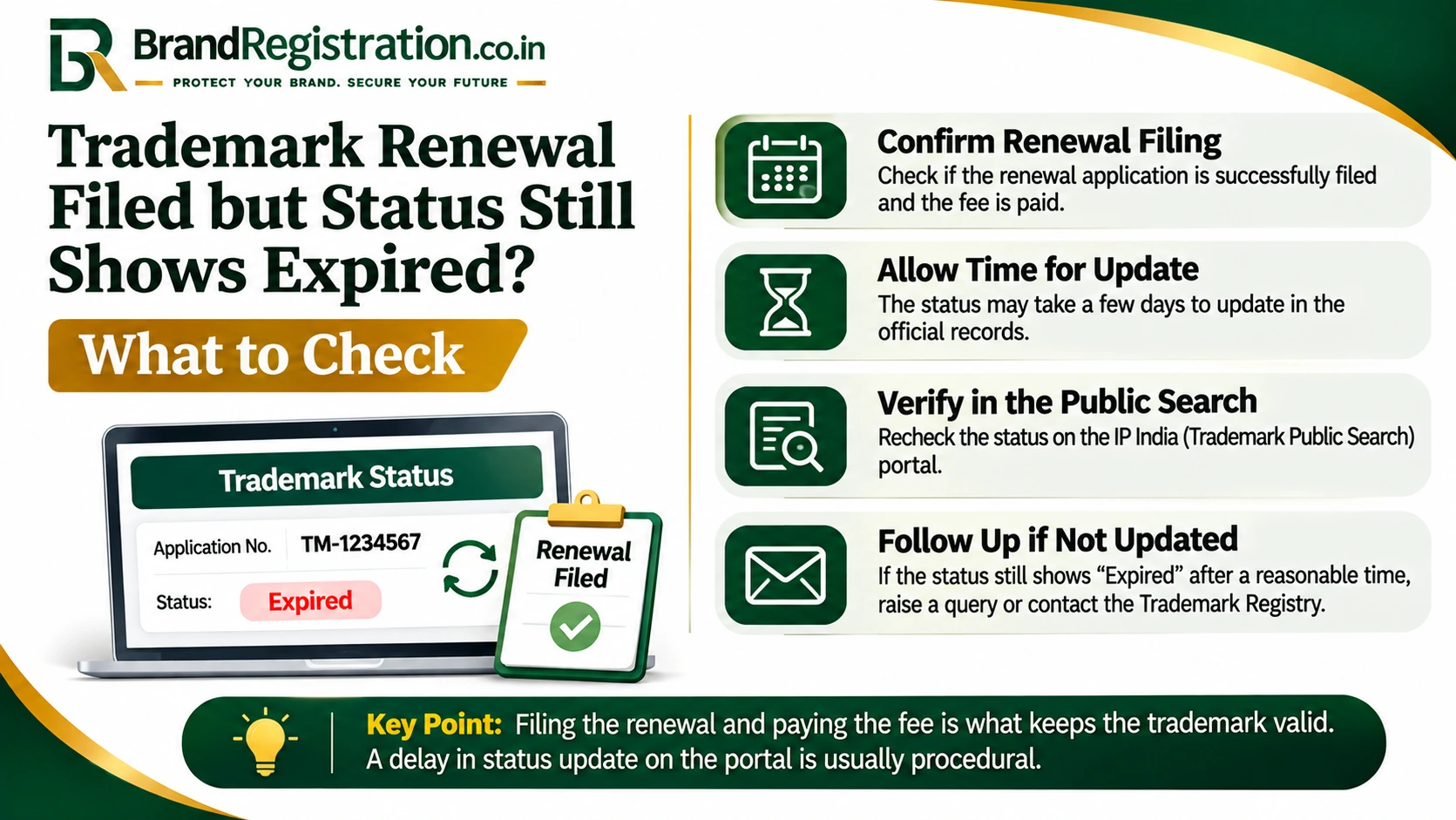
Table of Contents
If your trademark renewal was filed but the status still shows expired, first establish whether the renewal request was submitted, its payment was accepted, and the Registry has acted on it. An expired display alone does not tell you whether the request failed, remains pending, or needs a correction.
Compare the public record with the acknowledgement and payment evidence for the same registration. The next step depends on what those records show: tracking an existing request, resolving a payment or filing problem, or considering the appropriate late-renewal or restoration route.
1. Trademark renewal filed but status expired: what does it mean?
A trademark record contains several pieces of information that may answer different questions. The displayed status describes the registration record; a renewal request has its own filing history; and a payment record shows what happened to a transaction. Read them together before deciding that protection has ended or that a second application is necessary.
1.1 Read each part of the record separately
What you see | What it tells you | What it does not settle |
|---|---|---|
An expired status or an old expiry date | The public record has not shown the expected current position. | Whether an existing renewal request has been accepted, rejected or overlooked. |
A renewal acknowledgement | There is evidence of a request identified by the acknowledgement. | Whether the Registry has completed the renewal. |
A successful payment entry | A payment transaction was reported as successful. | Whether the correct request was submitted and linked to the correct registration. |
A removal entry | The record indicates a more serious change than an unchanged expiry date. | Whether removal was appropriate or what remedy is available in the individual case. |
A pending request and an expired display can coexist on the records you are viewing. Do not infer a guaranteed legal outcome from that combination: the filing date, nature of the request, payment and Registry action all matter. Equally, the absence of a fresh certificate is not a complete description of the register.
1.2 Keep a dated snapshot
Record what the official page actually says, rather than paraphrasing it as “renewal rejected”. Note the registration number, proprietor, displayed date and the date you viewed the record. A screenshot or saved copy can help you explain a change later, particularly if an agent or a former employee handled the original filing.
For a portfolio, compare one registration at a time. Similar brand names, different logo versions and different classes can produce records that look alike. A renewal relating to one record should not be assumed to cover another merely because both protect the same commercial brand.
2. Who can seek renewal or restoration?
2.1 Identify the registration and its proprietor
Renewal concerns an existing registered trademark. Section 25 of the Trade Marks Act, 1999 provides for a registration term of ten years and renewal for further ten-year periods. The person seeking renewal should establish the identity of the registered proprietor and the registration concerned; an agent may act for a proprietor where properly authorised.
Check the registration’s recorded expiry and any prior renewal history rather than counting from the date the certificate arrived. If the business uses several marks, identify the registrations separately. A business name, a logo and a word mark may represent different records, and their relevant dates need not be the same.
Where ownership details on the register differ from the person proposing to act, investigate the basis for that difference. A renewal request should not be treated as a substitute for establishing who owns the registration. The appropriate owner-record procedure depends on the underlying change and is separate from the status investigation in this guide.
2.2 Choose the route from the actual record
Situation | Question to resolve | Route to consider |
|---|---|---|
Existing renewal request is traceable | Has the Registry processed it, or is there an unresolved issue? | Track or follow up on that request before assuming a new filing is needed. |
Expiry has passed and no effective request is established | Which post-expiry provisions apply on the relevant dates? | Consider late renewal if available under the applicable law and rules. |
The registration has been removed | Is restoration available on the facts and within the applicable period? | Consider restoration and renewal, rather than treating the entry as a routine display delay. |
The available route is unclear or no longer available | What remains of the registration and what protection is needed? | Assess the position before deciding whether a fresh application is appropriate. |
“Expired” and “removed” should not be used interchangeably. Section 25 addresses removal for non-payment of the renewal fee and also provides for restoration in specified circumstances. The applicable periods, notice position and facts of the earlier filing matter; a missed date does not automatically establish either that restoration is available or that it is unnecessary.
A fresh application is a different legal step from renewing or restoring an existing registration. It should not be chosen solely to make an old status disappear. If removal is shown despite a documented renewal request, the proprietor needs the Registry’s record and a case-specific assessment before choosing between remedies.
3. Documents and information to assemble
Use this as an investigation checklist, not a claim that every item is a compulsory attachment to Form TM-R. Keep clear electronic copies for online work and retain the originals or original electronic files where available.
Registration number and a copy of the registration record or certificate: identify the precise mark, proprietor and registration being investigated.
Renewal acknowledgement or request reference: identify the request, its recorded filing details and the registration to which it relates.
Payment receipt and transaction reference: connect the amount and transaction date to the renewal request; retain a bank or payment-provider record if a Registry receipt is unavailable.
Copy of the submitted request, if available: establish what was entered and which service was selected.
Registry communications and the current record snapshot: show any query, decision or discrepancy that needs a response.
Authorisation for an agent, where applicable: establish the representative’s authority to act; use the form and format required for the representation.
Proprietor and contact details: support identification and communication. Where the proprietor’s identity has changed, retain the relevant supporting records for the separate issue.
3.1 Existing filing evidence
The most useful record is often the acknowledgement generated for the request itself. A bank debit can help trace a transaction, but it may not contain the trademark number or the submitted form. Preserve both when possible: they answer different questions and may have different reference numbers.
If a representative filed the renewal, ask for the complete submission record and subsequent Registry correspondence, not just an invoice marked paid. A professional invoice records the service provider’s charge; it is not a substitute for evidence of a government filing or payment.
3.2 Material for a new request or representation
For a request that still needs to be made, assemble the registration particulars and the proprietor’s details in a format that can be entered accurately on the official system. An agent may also need an authorisation. The current official form and filing interface determine what must be submitted; copies gathered for your own audit are not automatically mandatory attachments.
4. How to check and act on a renewal request
The workflow below separates preparing the facts, using the official record and deciding whether any further submission is justified. IP India provides access to trademark services through its official portal. A public record check and a filing-account history serve different purposes, so use both where you have access.
Prepare a list of the registration number, proprietor and mark.
Gather the existing request and payment references before opening the status record.
Go to IP India’s trademark services and locate the official status or record-search facility.
Open the record for the relevant registration and note the displayed status, expiry and available history.
Review the renewal request in the filing account, or ask the filing representative for its history.
Identify the request reference and whether any Registry communication or action is recorded.
Compare the request with its payment evidence.
A successful debit needs to be traceable to the relevant request; if the records do not connect, treat it as a payment or filing investigation rather than proof of completed renewal.
Choose the next action from the evidence.
If the existing request is pending, follow its progress or raise a focused enquiry. If no effective request is established, assess the available route and use Form TM-R where that route requires it.
After submitting any necessary request, save the acknowledgement and payment evidence.
Monitor the official record and respond to any Registry communication applicable to the case.
Do not create a second filing merely because the public display looks old. First establish whether the original request exists and what happened to it. Duplicate requests can make the history harder to reconcile and may create additional charges without resolving the original problem.
For a trademark renewal Form TM-R status enquiry, quote the request reference as well as the registration number. The latter identifies the trademark; the former helps identify the particular request you want reviewed. If the filing was made by someone else, the public view may not give you the same information as that person’s account history.
If you are protecting a new business name rather than renewing an existing registration, the process is different. Explore Trademark Registration for a new application; a renewal request cannot turn an unregistered name into an existing registered mark.
5. Government fees and professional charges
There is no reliable single total for every mismatch. The cost depends on whether the existing request was properly filed, whether another statutory step is needed, and whether you engage someone to investigate or represent you. The official schedule and the selected filing route determine government charges; a service provider’s quote determines its professional charges.
Cost component | When it may arise | What to ask for |
|---|---|---|
Government renewal fee | A renewal request requires payment under the applicable schedule. | The current official amount, filing mode and registrations covered. |
Additional statutory charge | A late or restoration route carries a charge under the applicable schedule. | The relevant fee category and how it is calculated. |
Professional fee | You engage an agent or service provider. | A separate quote for investigation, filing and follow-up. |
Further work or disbursements | The matter requires work beyond the agreed scope. | Which items are included and when approval is required. |
To budget, add the official amount for each applicable request and any additional official charge, then add the agreed professional fee and other quoted expenses. Do not add a second government filing fee merely because an agent has billed for investigating the first filing. Ask whether taxes, follow-up and responses to Registry queries are included in the quote.
A payment-success message is useful evidence, but fee verification also requires matching the transaction to the correct filing and fee category. If the money left your account but no corresponding filing can be located, retain the transaction details for reconciliation. Do not assume that paying again will automatically repair the first transaction.
6. Timeline: which milestone is delayed?
6.1 Separate filing from Registry action
There is no processing benchmark established by the evidence available for this guide. Instead of relying on an advertised turnaround, record the dates of submission, payment, any Registry query or response, and the last public-record check. These milestones show whether the delay concerns filing, payment reconciliation, substantive Registry action or the visible record.
A complete request awaiting action is a different case from a request awaiting a reply from the proprietor. Workload, an unresolved query, payment reconciliation and record discrepancies can affect the time a particular matter takes. The fact that another brand owner received an update quickly does not establish a deadline for your registration.
Set a follow-up date and keep a short contact log. Record whom you contacted, the reference supplied, the question asked and any response. This gives a new representative or internal team a useful history without requiring them to reconstruct the matter from invoices and scattered emails.
6.2 When the renewal certificate has not arrived
First distinguish a missing document from a missing renewal entry. If the record shows that renewal has been recorded but you lack the document, ask the filing representative or Registry about obtaining the relevant record. If the expiry date remains unchanged and no renewal action is visible, the investigation is broader than a certificate-delivery issue.
Keep the request reference and the date of the latest record view with any follow-up. A statement such as “certificate not received” is less useful on its own than a precise description of what the register and request history currently show.
7. Common causes of a mismatch and how to correct them
Use the discrepancy itself to frame the correction. The appropriate response depends on the evidence; a status problem should not automatically be described as a Registry error.
Wrong record viewed: Similar marks or separate registrations can be confused. Reopen the record using the registration number and compare the proprietor and mark before treating the status as belonging to the request.
Payment cannot be linked to a request: A debit or payment message may exist without a traceable completed submission. Gather the payment references and request history, then seek reconciliation through the relevant official channel.
Request details differ from the intended registration: Compare the submitted particulars with the register. Explain the specific discrepancy in a follow-up and establish the appropriate correction route rather than assuming it can be changed informally.
Registry query has not been answered: Read the communication and its applicable response requirements. An enquiry about the display is not a substitute for answering the actual query.
Record has not reflected an action: If the request history shows an action but the public record appears inconsistent, identify both entries and ask for the discrepancy to be reviewed.
Removal is shown despite an earlier filing: Preserve the filing history and removal details. The dates and the Registry’s reasons are material to deciding whether to challenge, seek correction or consider restoration.
Avoid describing a payment failure, a pending request and removal as the same problem. A vague complaint makes it harder for the recipient to identify the action you need.
For a trademark renewal complaint to IP India, use the relevant contact or grievance route provided on the official portal. State the registration number, request reference, payment reference where relevant, dates, the exact status displayed and the correction or information sought. Attach or supply supporting records as the channel permits, and retain the acknowledgement of your enquiry.
If the record shows removal, a disputed filing date or an unclear ownership position, obtain case-specific legal help promptly. Those situations may involve limited statutory opportunities and consequences that cannot be resolved from a status label alone.
8. After the Registry records the renewal
Compare the recorded proprietor, mark, registration number and renewed expiry with your internal portfolio entry. Save the renewal evidence with the earlier registration material and any correspondence that explains a correction. The goal is to make the next review possible even if the original agent or employee is no longer available.
Create a separate calendar entry for each registration and assign an owner responsible for monitoring it. Use more than one reminder before the next due date, and record where the supporting files and filing-account details are held. A portfolio spreadsheet should also identify who can approve government and professional expenditure.
Keep contact and representative details usable for future communications. A renewal does not remove the need to monitor other matters affecting the mark, including disputes or changes in the business. For a new application, “under examination” describes an application being examined; it should not be read as a renewal decision on an existing registration.
A company’s legal name and its brand name can be different. What matters for this task is matching the registered trademark and proprietor to the record you are maintaining, rather than assuming that a company-name record automatically updates a trademark record.
9. Your next three actions
If the request is identifiable, compare its acknowledgement, payment and current record, then follow the existing request or raise a specific discrepancy.
If no effective request is established, determine the available renewal route from the registration history and applicable law before making a new submission.
If the mark is shown as removed, or the filing and ownership history is disputed, preserve the evidence and obtain an assessment of the available remedy without delay.
Begin the process online via the official government portal, or engage Brand Registration for end-to-end assistance
Frequently Asked Questions
Does an expired status mean my trademark renewal failed?
Not necessarily. Compare the registration record with the renewal acknowledgement, payment evidence and request history. An unchanged display alone does not establish whether the Registry has accepted, rejected or yet to act on the request.
Does successful payment prove that Form TM-R was filed?
A successful payment shows a reported transaction, but it does not by itself establish that the correct renewal request was submitted and linked to the correct registration. Look for the filing acknowledgement and request reference as well.
What should I do if my renewal certificate has not arrived?
Check whether renewal has been recorded and whether the expiry date has changed. If renewal is recorded but the document is missing, ask the filing representative or Registry about obtaining the relevant record. If the record remains unchanged, investigate the request itself.
Is trademark renewal the same as restoration?
No. Renewal extends an existing registration under the applicable provisions. Restoration concerns a registration that has been removed and is available only in the circumstances provided by law. The record and relevant dates determine which route may apply.
How much does trademark renewal cost in India?
The total depends on the applicable official fee category, filing route and any professional charges. Ask for a breakdown of government fees, additional statutory charges and the representative's fees using the current official schedule.
How long does a trademark renewal status update take?
The supplied evidence does not establish a reliable current processing benchmark. Track the submission, payment, Registry communications and subsequent record changes separately, since the source of delay can differ between cases.
What does under examination mean in a trademark record?
It generally describes an application being examined. It should not be treated as a decision on the renewal of an existing registration. Read the status in the context of the particular application or request.
Can a company name and brand name be different?
Yes. A company can use a brand name that differs from its legal name. For renewal, identify the particular registered trademark and the proprietor shown in the trademark record; a company-name record does not automatically update that record.
Recent Blogs
Licenses
Your Trademark Has Not Been Used for Years: Can Someone Seek Its Removal?
27 November 2026

Licenses
Trademark Owner Has Passed Away: What Can Legal Heirs Do About the Registration?
27 November 2026
Licenses
Trademark Registered in Your Personal Name? How Can You Transfer It to Your Company?
27 November 2026