Trademark Filed as “Proposed to Be Used” but Your Business Has Started Selling: What Should You Do?
23 November 2026

Table of Contents
If your Indian trademark application accurately said “proposed to be used” when you filed it, starting sales afterwards does not make that original statement false. Keep evidence of the later use, monitor the application and assess whether there is a specific reason to approach the Trade Marks Registry; do not assume that every first sale requires an amendment.
For a trademark proposed to be used after starting business, the decisive question is when use of the particular mark began in relation to the application date. A sale after filing and an overlooked sale before filing call for different decisions.
There is no confirmed regulatory change in the supplied information that requires all applicants to convert a proposed-use claim when sales begin. The guidance below separates the existing application record, your business records and any request you might make to the Registry.
1. Trademark proposed to be used after starting business: 2 dates to separate
1.1 What the original statement means
A proposed-to-be-used statement describes the position at the time of the application: the applicant sought protection for a mark intended for use, rather than claiming that use had already begun. An application can be filed before a product launch or before a service starts trading under the brand.
The filing date is the date associated with the application. The first-use date is a factual question about use of the mark in relation to goods or services. Those dates perform different jobs; one does not automatically replace the other when a business starts trading.
Section 18 of the Trade Marks Act, 1999 addresses applications by a person claiming to be the proprietor of a mark used or proposed to be used. Rule 25 of the Trade Marks Rules, 2017 addresses the statement of use in an application and the affidavit requirement when earlier use is claimed.
1.2 What has changed—and what has not
Sales change your commercial history. They do not, by themselves, rewrite the information submitted on Form TM-A or guarantee that the Registry’s public record will display a new user date. Equally, a proposed-use entry should not be read as proof that the business never began using the mark.
Think of the Registry record as a record of the application and its processing, not as a live sales register. The status of an application, such as a pending examination or an objection, is also different from the statement about use made in the application.
Commercial use can become relevant to a later dispute or Registry proceeding, but its value depends on the facts and evidence. A later sale does not turn the application into a claim that the mark was used before it was filed.
2. Who needs to act, and what kind of action fits?
Every applicant who has started trading benefits from keeping an accurate internal record. A request to change the Registry record is a separate decision, and its suitability depends on what was stated originally and what the applicant now wants the Registry to do.
Situation | Immediate decision | Why it differs |
|---|---|---|
The mark was first used after filing | Preserve evidence and monitor the application. | The original proposed-use statement may have been accurate. |
The same mark may have been used before filing | Review the original claim and the supporting records before considering correction. | The issue is a possible error about the position at filing. |
Trading began under a different mark or by a different entity | Compare the application with the actual trading arrangement. | A later sale may not establish use by the applicant of the mark as filed. |
2.1 Use began after filing
If the application accurately recorded proposed use and the first relevant use came later, there is no reason to treat the application as automatically defective simply because the business is operating. Keep the evidence available for a genuine future need, including a dispute or a Registry request.
You may nevertheless have a specific reason to seek advice about putting information on the record. That is different from assuming that a standard update is compulsory or that the Registry must accept a particular change to the user claim.
2.2 Use may have begun before filing
If records show use of the relevant mark before the application date, the proposed-use statement deserves closer attention. Section 18(4) allows the Registrar to permit correction of an error in or amendment of an application on terms considered just; it does not establish that every requested change to a user claim will be allowed.
Rule 25(2) requires an affidavit testifying to use, with supporting documents, where use prior to the application date is claimed. The records and the appropriate procedural route need assessment before a claim is made. Do not supply a date merely because it would appear more favourable.
2.3 The business changed but the applicant did not
Check who applied and who actually trades under the mark. A founder might apply personally while a company later sells the product, or one group company might use a mark applied for by another. Those arrangements raise questions about ownership and use that cannot be answered simply by inserting a sales date.
The application also relates to identified goods or services. A sale of an unrelated product, or use of a materially different logo, should not be treated as automatic evidence of use of everything described in the application.
3. Documents to build a reliable use record
Create a dated file for the mark now, rather than trying to reconstruct the launch years later. The aim is to show what customers encountered, who used the mark and how that use connects to the relevant goods or services.
Keep the filed TM-A, application number, mark representation and goods or services description together.
Preserve dated customer-facing material showing the mark, such as product labels, a service page or an advertisement.
Retain transaction records, such as invoices, orders or payment records, and connect them to the branded product or service.
Keep records identifying the trading entity and, where relevant, its relationship with the applicant.
Save later examples at sensible intervals so the file does not rely on one launch-day document.
3.1 Connect the mark to an actual transaction
An invoice can establish a transaction without displaying the brand. In that case, preserve the product description, order reference and a contemporaneous image or listing that connects the item to the mark. A screenshot alone may show a presentation of the brand but not establish that a sale occurred.
For a service, an accepted proposal, booking record or invoice can be paired with the branded material the customer saw. For physical goods, the packaging or label may be as useful as the payment record. The documents should support the story together rather than leaving the connection to memory.
A business may have promoted a mark before making its first sale. Do not assume that the first invoice necessarily fixes the first legally relevant use date, or that every advertisement necessarily qualifies as use. Identify the earliest activity and its context before making a dated claim.
3.2 Organise the evidence
Make a simple chronology with the date, document, mark shown, goods or services, trading entity and customer or audience. Keep original electronic files where possible, alongside readable copies. Note whether a screenshot was captured at the time or reconstructed later from an archived page.
If a record contains confidential customer information, keep an unredacted version securely and prepare a redacted working copy where appropriate. Do not alter dates or crop out information in a way that changes what a document conveys. If a document has an obvious limitation, record that limitation in the chronology.
3.3 When an affidavit matters
An affidavit is a sworn statement, not a substitute for the underlying records. The Rule 25(2) requirement concerns a claim of use before the application date; it should not be treated as a universal instruction to file an affidavit immediately after a later sale.
If an affidavit is needed for a specific claim or proceeding, the statement should be consistent with the supporting evidence and identify the relevant mark, user and period accurately. Filing a document does not itself guarantee that the Registry will amend the application or accept every assertion in it.
4. Step-by-step: review the application and choose a filing
The IP India Trade Marks Registry’s online services are the starting point for reviewing an Indian application. Before selecting a form, decide what information or correction you are actually seeking to place before the Registry.
Retrieve the application. Use the application number to review the record, the mark, applicant, goods or services, use statement and current procedural status. Compare the public record with the filed application and any later correspondence.
Map the dates. Put the filing date beside the earliest relevant use shown by your records. Record uncertainty where the evidence supports a period but not a precise day.
Identify the purpose. Decide whether you are preserving evidence of a later event, correcting a possible error in the original application or responding to a specific Registry communication. These are not interchangeable tasks.
Assess the route before filing. Form TM-M is used for various requests to the Registry, including certain requests concerning applications. Section 18(4) provides for permitted correction or amendment, but a request to insert a post-filing use date is not automatically a valid or successful conversion.
Prepare and submit only the appropriate request. If a request is justified, use the relevant option available through the IP India trademark e-filing system, state the relief sought accurately and provide supporting material appropriate to that request. Keep the submission acknowledgement.
Follow the record. Review subsequent communications and the application record for the Registry’s response. A submitted request is not the same as an accepted amendment.
4.1 Review the Registry record
Do not rely only on a status label. Open the available documents and communications: a status may tell you where the application is in the process without explaining what action, if any, is required. Keep copies in your own file so the business can reconstruct its decisions later.
If an agent filed the application, obtain the application papers and relevant communications from that agent. Make sure the applicant’s contact details and internal responsibility for monitoring are clear; an unanswered communication can matter even when sales are going well.
4.2 Decide whether a request is justified
For an accurate proposed-use filing followed by a later launch, keeping the evidence may be the appropriate immediate step. If an earlier-use statement was omitted or another factual error is suspected, frame the issue as a request for the relevant correction rather than as a routine post-sale update.
Write a one-sentence objective before opening a form: “I want the Registry to consider correcting an error in the original application” is different from “I want to keep proof that sales began later.” The first may require a procedural request; the second can often begin with your own records.
4.3 Track the outcome
Save the acknowledgement, request and attachments as a set. If the Registry asks for clarification, respond to the actual point raised. Until a change is reflected in the Registry’s decision or record, avoid describing it to customers, investors or counterparties as an approved amendment.
5. Fees, processing time and the cost of waiting
There is no verified flat government fee in the supplied evidence for automatically changing every proposed-use application after a first sale. The applicable fee, if any, depends on the request and filing route; the Registry’s current fee schedule and the selected e-filing option matter.
Record keeping: Internal collection of invoices and launch materials is separate from a Registry filing.
Registry request: A filing fee may apply to the particular request made.
Preparation: Professional drafting, evidence review and affidavit-related expenses may be separate costs.
Response: An objection, hearing or dispute can involve work beyond the original application.
5.1 Budget by task
Ask for an itemised estimate that separates government charges from service charges and explains what each covers. If a request is being proposed, identify the form option, the intended outcome and whether responding to a Registry query is included. That makes it easier to compare paying for a filing with paying for a review of whether one is useful.
Also account for the time spent locating older records. Evidence collection has a real business cost even when no government submission is made. Assigning a person to preserve launch material early can prevent a later search across former employees, agencies and marketplace accounts.
5.2 Separate the clocks
There are at least three timelines: when use began, when any request is processed and when the underlying trademark application progresses. A request for correction is not a shortcut to registration, and starting sales does not itself complete examination or resolve an objection.
Processing times vary with the application and the Registry’s workload. A business can organise its evidence immediately, but it should not plan a launch or transaction on the assumption that an amendment or registration will be completed by a particular date.
6. What happens if the Registry raises a concern?
6.1 Read the issue before responding
An examination report may raise concerns about registrability or other aspects of the application. Read the specific objection and its response instructions. Evidence that a business made sales after filing may be relevant in some circumstances, but it does not automatically answer every objection.
For example, a concern about similarity with an earlier mark requires attention to that concern. A collection of invoices does not by itself establish that the marks can coexist or that the applicant has better rights. Preserve the distinction between demonstrating your own trading history and resolving the legal issue identified by the examiner.
If a notice asks for a response, organise the evidence around what it actually requests. Include the application number and make clear which documents support which statement. A focused response is more useful than uploading a large, unexplained bundle of unrelated business records.
6.2 Show-cause hearing
A trademark show-cause hearing is an opportunity for the applicant to address concerns raised in examination before the Registry decides how to proceed. The notice and the issues in the application determine what should be addressed; a hearing is not the same as a registration certificate.
Prepare an issue-by-issue account of the objection, your response and the documents you intend to rely on. If use after filing is relevant, present its actual dates without suggesting that it occurred before the application. Follow the directions in the hearing communication for participation and submissions.
7. Maintain protection as the business grows
7.1 Monitor the mark and the application
Give one person responsibility for reviewing Registry communications and recording deadlines. Keep a shared application file accessible if staff or agents change. A business that has begun selling may be busy with operations, but the application still needs active attention as it moves through the Registry.
Use a consistent brand presentation and retain examples when it changes. Small design developments and major rebrands raise different questions; assess the mark actually filed against the mark customers now see rather than assuming that every variation has identical coverage.
Monitor the market for confusingly similar branding as part of ordinary brand protection. If a conflict appears, preserve examples and dates before making assertions about priority. The outcome can depend on the competing marks, goods or services, use and other circumstances.
7.2 Match protection to the business
Brand registration is a process for seeking protection of a trademark; filing an application is not the same as obtaining registration. Review whether the existing description still matches the goods or services the business plans to offer. Expansion into another line may require a separate protection decision rather than an assumption that the original application covers everything.
A company name and a brand name can be different. For instance, a company may trade under a separate product name, but the trademark application should still identify the appropriate applicant and the mark for which protection is sought. Changing the company’s name, ownership structure or trading entity may require a review of the trademark records.
For readers asking how to trademark a business name, the relevant route is a trademark application for the name as a mark, with appropriate goods or services, through the IP India system. Copyright is a different form of protection: a business name alone is generally not protected as a copyright work. A logo or other original creative material may raise separate copyright questions.
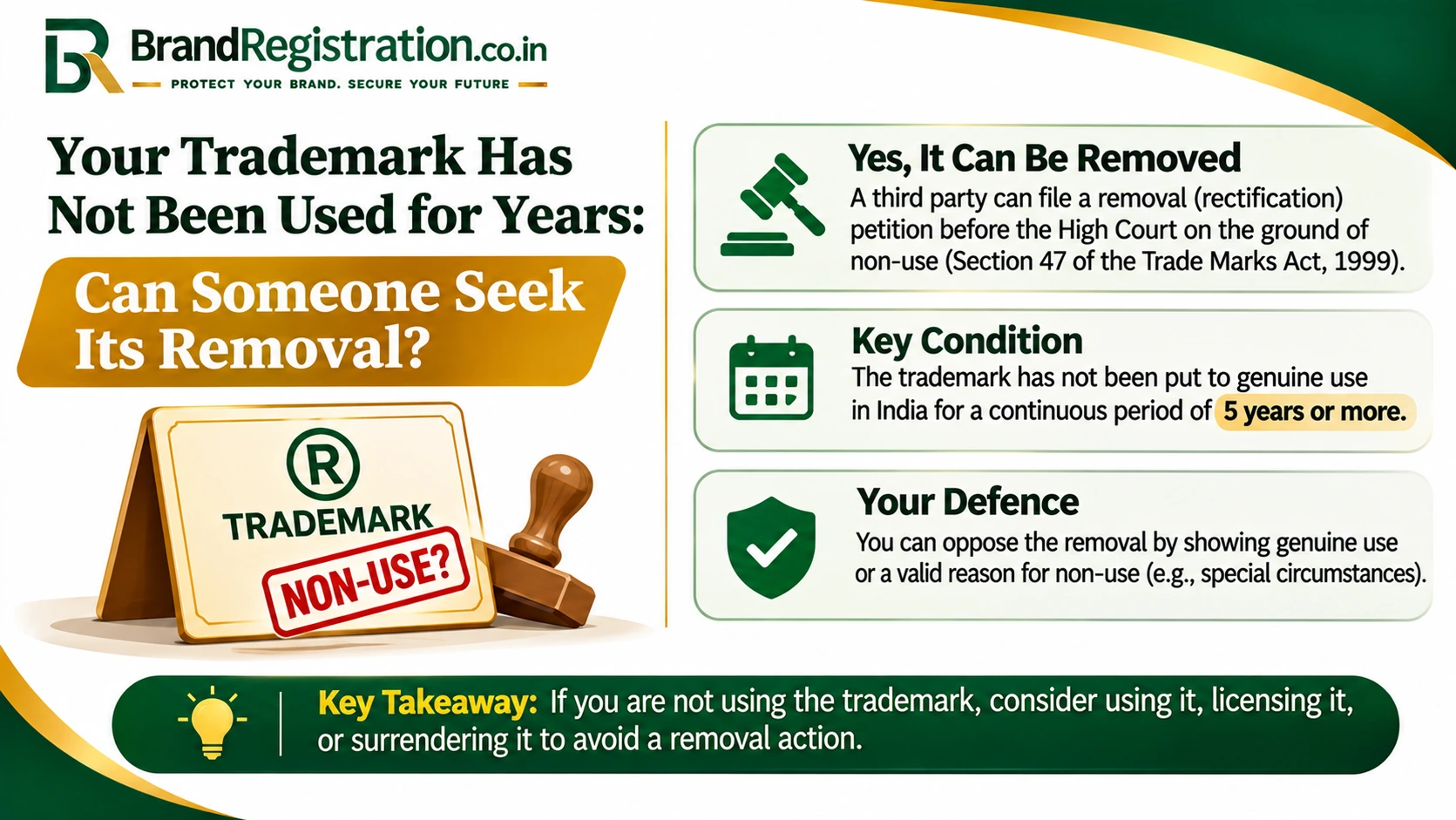
Once a mark is registered, keep track of its registration and renewal requirements as well as evidence of genuine use. Non-use can matter to a registered mark under Section 47 of the Trade Marks Act, subject to the statutory conditions and defences. Do not treat a certificate as a reason to stop maintaining records.
8. Avoid mistakes that weaken the record
Backdating the claim: Do not select an earlier user date simply to strengthen the application. Record the date supported by the facts and identify uncertainty.
Treating a launch plan as a completed transaction: A draft advertisement, internal design approval or domain purchase may help explain preparation, but it does not automatically prove the customer-facing use you claim.
Mixing marks: An invoice for one brand and packaging for another do not establish use of the filed mark without a clear connection.
Mixing users: Explain the relationship between the applicant and the entity shown on sales records instead of assuming their names are interchangeable.
Calling a request an approval: Keep the filing acknowledgement and the Registry’s eventual response distinct.
Discarding inconvenient records: Gaps, changed designs and inconsistent dates need explanation; removing them does not make the underlying history more accurate.
Be particularly careful when a marketplace listing was edited after launch. A current page may show today’s mark and price, not what customers saw on the date of the first order. Preserve dated snapshots and transaction records as separate items.
If a document conflicts with another, record the discrepancy before using either in a declaration. For example, an order date and a dispatch date can differ for an ordinary commercial reason. The right date to state depends on the claim being made and the evidence as a whole, not on whichever date looks most useful.
9. Choose your next step
Use the scenario that matches your records, then assign an owner and a date for the action:
First relevant use was after filing: Put the launch evidence in a dated file and continue monitoring the application. Consider a Registry request only if there is a specific procedural reason for it.
Relevant use may have existed before filing: Assemble the original application and contemporaneous evidence, then assess the possible correction and supporting affidavit before making a new claim.
The mark, trader or goods differ from the application: Map those differences first. Decide whether the issue concerns evidence, ownership, the scope of the existing application or a separate protection decision.
A Registry communication is pending: Identify the issue and response instructions in that communication, and deal with it on its own terms.
Your next action should match the fact you need to establish: a later launch, an earlier error or a change in the business. Do not spend money on a supposed status conversion before identifying the outcome you need.
Take the next step with Brand Registration or the relevant government portal
Frequently Asked Questions
Must I update a proposed-use application after my first sale?
An accurate proposed-use statement does not become false simply because use starts later. Preserve evidence and monitor the application; a Registry request should have a specific procedural purpose.
Can a later sale make my original application inaccurate?
A sale after filing does not by itself make a statement about the filing date inaccurate. The concern is different if the relevant mark was already in use before filing and the application incorrectly said it was proposed to be used.
Can I use TM-M to add a post-filing use date?
TM-M covers various requests to the Trade Marks Registry, but it is not an automatic conversion of every proposed-use claim. The appropriate request and whether it will be accepted depend on the circumstances and Registry procedure.
Is a use affidavit automatically required after filing?
Rule 25(2) requires an affidavit and supporting documents where use before the application date is claimed. It should not be treated as a general requirement to file an affidavit immediately after a later sale.
Does the first invoice always establish the first-use date?
No. Earlier customer-facing activity may be relevant, while an invoice may not itself identify the mark. The date and nature of use must be assessed from the records and circumstances.
What if the brand was already in use before filing?
Compare the original application with dated evidence of the relevant mark, goods or services and user. A possible correction should be assessed before making an earlier-use claim, with attention to the affidavit requirement under Rule 25(2).
Will recording a later use date automatically give me priority over another business?
No. A later use date does not automatically settle a priority dispute. The competing marks, goods or services, dates, evidence and other legal circumstances may all matter.
Can my company name and trademark be different?
Yes. A company can trade under a separate brand name. The application and supporting records should accurately identify the applicant, the mark and the relationship between the applicant and the trading business.