Claiming Prior Use of a Trademark but Don’t Have Old Invoices? What Evidence Should You Check?
23 November 2026
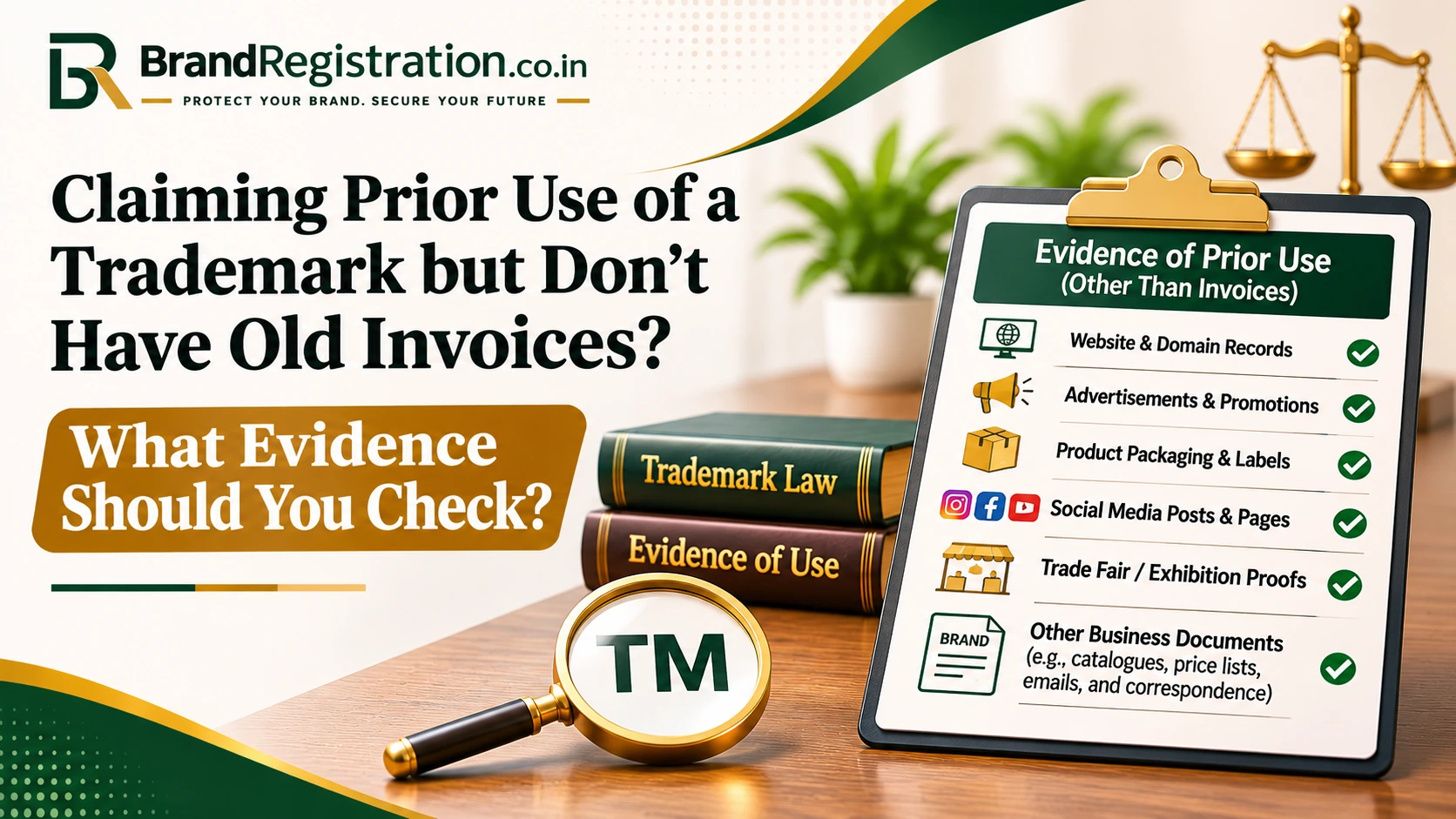
Table of Contents
You can build trademark prior use evidence without invoices by looking for dated records that connect your mark to your goods or services and the business using it. If you claim use before filing, Rule 25(2) of the Trade Marks Rules, 2017 requires an affidavit testifying to that use, with supporting documents; old sales invoices are not the only records worth examining.
The strength of a claim depends on what the surviving records actually show. A dated advertisement, for example, may help establish that a brand was promoted, while a separate business record may help connect that promotion to the applicant. Neither should be made to say more than it does.
This guide helps you identify useful material, choose a supportable date and understand how a prior-use claim fits into an Indian trademark application. It also explains when an incomplete ownership history or a Registry objection makes specialist help worthwhile.
1. Trademark prior use evidence without invoices: what counts?
1.1 The legal role of a prior-use claim
A prior-use claim tells the Trade Marks Registry that the mark was already being used before the application was filed. The date matters because the application presents a history of commercial activity, rather than merely an intention to adopt the mark later.
Rule 25(2) requires an affidavit and supporting documents for a claim of use before the application date. The requirement is to support the asserted use; the usefulness of a particular document depends on its contents and context. An affidavit is a statement of the claim, not a substitute for the supporting material required by the rule.
Trademark prior user rights in India are a broader issue than completing a filing field. Section 34 of the Trade Marks Act, 1999 protects certain earlier users against interference by a registered proprietor, subject to its conditions. A date entered in an application does not by itself establish those rights or decide a dispute with another business.
1.2 What the evidence must connect
Read each potential record against four questions: does it show the mark, identify the relevant goods or services, place the activity at a meaningful date, and connect the activity to the applicant or a relevant predecessor? For use claimed in India, the connection to the Indian market also matters. A single record may answer only one or two questions; several records can be read together.
Trademark proof of commercial use is different from evidence that a name was considered internally. A draft logo file may show a design existed, but it does not necessarily show that customers encountered the mark. Equally, a business transaction may show commercial activity without showing which brand appeared to the customer.
2. Who can claim an earlier use date?
2.1 Applicant, mark and commercial activity
A prior-use claim is relevant where an applicant can truthfully identify use of the mark before the filing date in relation to the goods or services covered by the application. The use and date claimed should reflect the activity for which the applicant has a proper basis, rather than the age of the business in general.
Identify the applicant that will own the application: an individual or a business entity, as appropriate to the ownership facts. A company is not a prerequisite for every trademark application.
Identify the mark being filed and distinguish a word mark from a particular logo or visual presentation.
Define the goods or services for which the mark was actually used; a long business history does not automatically cover every item in a broad specification.
Choose an asserted date that can be supported honestly, taking account of the nature and location of the use.
Consider whether earlier activity was by the applicant, an earlier owner or another business, and whether the applicant has a basis to rely on it.
For someone asking how to trademark a business name, brand registration generally starts with identifying the owner, the name to be protected and the relevant goods or services. A trademark application is assessed on the mark and its claimed use; registering a business or using a name does not automatically register that name as a trademark.
2.2 Business name, brand name and ownership
A company name and a brand name can be different. A company may sell under a product brand that never appears in its legal name, so the applicant must be able to explain the relationship between the entity and the mark. The same question arises for a sole proprietor trading under a separate business name.
Where a founder used a mark personally and a later company now owns it, the two are separate legal persons. The earlier activity may be relevant, but do not assume a seamless transfer merely because the same people run both. A change in ownership, a licence or other arrangement can require a closer legal assessment before the application is framed.
A date should be selected for the mark and the relevant goods or services, not borrowed from the date a company was incorporated, a domain was purchased or an idea was first discussed. Those events may form part of the history, but they answer different questions from use of the mark in trade.
3. Documents to check when old invoices are missing
There is no value in assembling a large folder that cannot answer the four questions above. Sort potential trademark user affidavit supporting documents by date and purpose, and retain complete copies with their source information. The following are practical evidence categories, not a government-prescribed list of substitutes that must all be submitted.
3.1 Affidavit and evidence index
A trademark user affidavit without bills should state the use being claimed truthfully and identify the person making the statement and their relationship to the applicant. It can explain the mark, the relevant goods or services, the claimed date and the basis on which the applicant relies on the history. Where ownership has changed, a clear account of that history helps a reader understand whose activity is being described.
Refer to supporting records as numbered exhibits so the Registry can follow the account. Keep the underlying files or originals where available, and prepare readable copies for submission. Affidavit execution and filing formats should follow the applicable requirements for the particular filing; an evidence index is a practical presentation aid, not a separate statutory form.
3.2 Records that show the mark in the market
Packaging, labels and product photographs: Trademark packaging evidence can show how the mark appeared on goods. A physical label without a reliable date may establish appearance but leave timing open; a dated print order, photograph or distribution record can help place it in context.
Advertisements and publications: A dated advertisement, catalogue, brochure or media publication may show the mark and the goods or services offered. Keep the page or file with its publication date and publisher information, rather than an isolated crop of the logo.
Social media and online listings: Trademark social media proof of use may include dated public posts, account details and product or service descriptions. Capture the post in context, including its date and account identity; a creation date or follower count alone does not establish the full history of use.
Webpages and archives: Trademark website archive evidence can show an earlier public-facing page. Preserve the archived page, capture date, address and relevant content. An archive capture shows what was recorded at that time; it does not necessarily identify the first day the page or mark was used.
Third-party material: Dated marketplace listings, distributor catalogues or independent coverage may corroborate the brand’s public presence. Check that the material identifies the relevant mark and offering, and record how the third party is connected to the business.
For trademark advertisement proof of use, the distinction between a finished advertisement and a campaign that actually reached the market is useful. A designer’s draft or proposed media plan may explain preparation, while a dated publication or campaign record can help show outward-facing activity. Keep both when the surrounding history matters, but describe each accurately.
3.3 Records that support transactions and dates
GST records: Trademark GST records evidence may help establish that an identified business conducted relevant activity during a period. A return or registration record that contains only the legal entity’s name does not, by itself, show which brand appeared on the goods or services. An accessible GST Portal record can be paired with material that makes that link.
Orders, payment records and correspondence: Customer orders, payment confirmations or dated exchanges may help place an offering in commerce. Their value increases when the record identifies the branded product or service and the business supplying it; a bank entry alone may identify neither.
Supplier and distribution records: Packaging orders, fulfilment records or distribution correspondence may help connect production and commercial rollout. A supplier invoice for labels is not a customer sale, so describe it as evidence of the activity it records.
Ownership records: Agreements and other records concerning an assignment, licence or change in business structure may help explain who used or controlled the mark and when. Their effect depends on their terms and the surrounding facts.
Check whether a former accountant, marketplace account, payment provider, printer or distributor retains records you no longer hold. Ask for existing copies or account exports, not a newly created document presented as an old one. If a document contains customer information, consider whether a readable, appropriately limited copy can serve the evidential purpose while protecting unnecessary personal details.
3.4 How to assess each exhibit
Make a simple evidence matrix with columns for date, source, mark shown, goods or services, business connection and limitation. A record that proves the transaction but omits the brand can then be paired with a dated record that shows the brand and identifies the same offering.
Look at the exact mark visible in each exhibit. A word used consistently in several logo styles may be relevant to a word-mark application, while evidence of one graphic does not automatically demonstrate use of a materially different logo. Keep the full context available so the relationship can be assessed rather than inferred from a cropped image.
For trademark use proof without sales invoices, a coherent sequence is often more informative than a single impressive item: an early public-facing record, a record connecting the offering to the applicant, and later records showing how the activity continued. This is a practical way to organise evidence, not a guarantee that the Registry will accept the claim.
4. How to prepare and file the claim
4.1 Preparation
Before entering an application, settle the applicant details, mark, goods or services and the date the applicant is prepared to assert. Search the IP India public trademark search facility for potentially conflicting marks as part of the filing decision. A search is a risk-assessment step; it does not guarantee that an application will be accepted or resolve every unregistered-rights issue.
4.2 Submission
Use the IP India trademark e-filing system to prepare a new application in Form TM-A. Select the relevant application details and classification for the goods or services actually sought.
Enter the use claim and date as supported by the applicant’s account. Prepare the affidavit and its supporting material for submission with the application in accordance with the applicable filing requirements.
Review the complete application, attachments and fee shown for the chosen filing details before submission. The applicant should understand the declaration being made and retain the final version submitted.
Submit through the e-filing system and save the application number and acknowledgement. These provide the reference for tracking the case and organising later correspondence.
4.3 After submission
If an application has already been filed, first inspect what was actually claimed and uploaded. A missing attachment, an asserted date that needs attention and a request to alter a claim are different situations; do not assume that uploading a replacement file automatically changes the application or preserves a particular legal position. The appropriate route depends on the application record and the issue being addressed.
For a disputed ownership history, a material change to a claim, or an objection that challenges the evidence, consider assistance before making further statements. Brand Registration can assist with the filing and brand-protection process; the owner remains responsible for giving an accurate account and supplying genuine records.
5. Fees and timing: what to budget for
5.1 Cost categories
Government application fee: depends on the filing details and applicable fee category.
Evidence preparation: may involve retrieving records, obtaining copies and preparing exhibits.
Affidavit execution: may involve charges separate from the application fee.
Professional assistance: depends on the agreed scope and is separate from government charges.
Later proceedings: an objection, hearing or opposition can add work and may involve further costs depending on the action.
The fee for filing a trademark application should not be confused with the cost of reconstructing a business’s evidence. A quote for filing alone may not include work on an affidavit, review of an ownership chain or representation in later proceedings. Ask for a written scope that separates those items rather than comparing only the headline price.
The applicable official fee is the one for the chosen application and filing category under the current IP India fee schedule. The e-filing review stage gives the applicant an opportunity to inspect the charge before paying; service-provider charges should be assessed separately.
5.2 Milestones and variables
Allow time first for internal record retrieval and preparation. That period is within the applicant’s control to a degree, but an archive held by a former provider or an unresolved transfer may take longer to reconstruct than a set of readily available files.
After filing, the application moves through Registry examination and, if it proceeds, publication and any subsequent stages applicable to the case. An objection, request for clarification, hearing or opposition can change the course and duration. A filing acknowledgement is not a registration certificate, and an estimated completion date is not a guarantee.
6. Mistakes that weaken a prior-use claim
Do not backdate a record or state a date as fact merely because it makes the brand appear older. An unsupported assertion can undermine credibility when the application or a later dispute is examined.
Confusing business age with mark use. An established business may have introduced a particular brand later. Correct the account by separating the business start date from the date of the relevant branded activity.
Overstating what a record shows. A payment entry, internal mock-up or undated package may be useful context but may not prove public use on the claimed date. Identify its limitation and seek an independent link rather than describing it as a sales record.
Ignoring a break in identity or ownership. A founder, partnership and company may be related commercially but are not necessarily the same applicant. Set out the sequence and obtain advice on the effect of the relevant arrangements if the applicant relies on another party’s use.
Claiming goods or services beyond the evidence. A record for one offering should not be presented as proof of use across an unrelated range. Reassess the specification and the claim so the application reflects the available facts.
Using an indistinct or altered exhibit. A crop that removes the date, source or surrounding product information may make the document difficult to assess. Replace it with a legible, contextual copy and keep the source file available.
Assuming every later date fixes an earlier claim automatically. If the oldest supportable evidence is later than the date already asserted, the case may need a careful review. The correction route and its consequences depend on the application’s status and facts.
7. After filing: protect the evidence and monitor the case
Use the application number to monitor the case through IP India and keep an accessible copy of every communication. A change in status is a prompt to read the underlying document, not merely the status label: an examination report, for example, may raise points that need a specific response.
A show-cause hearing in a trademark matter is an opportunity for the applicant or representative to address concerns raised in examination before the Registry makes a decision on those issues. The hearing notice and examination record determine what needs attention. It is not proof that the application has already been accepted, and it is not the same thing as an opposition by another party.
Keep the submitted application, affidavit, exhibits, acknowledgement and later correspondence together.
Preserve new dated examples of use as the business operates, including records that connect the mark to the relevant offering.
Record changes in ownership or licensing arrangements and retain the underlying documents.
Read Registry notices promptly and manage the response requirements applicable to the particular notice.
Maintain source files as well as submission copies, so the context of an exhibit can be reconstructed if questioned.
Trademark continuous use documents are useful for more than an initial filing. A later challenge can concern different periods or issues, so preserve a proportionate record over time rather than assuming that the first evidence bundle answers every future question. Ongoing recordkeeping is a practical safeguard; the obligations and consequences in a particular proceeding depend on the applicable law and facts.
8. Choose your next three actions
Build the timeline. Identify the mark, owner and offering, then list the earliest credible dated events. If the date you remember is not supported, do not treat memory as a substitute for the required supporting material.
Test the evidence. Assemble the affidavit and supporting records around what each item actually proves. If the evidence supports only a later date or a narrower activity, frame the decision around that limitation rather than stretching the claim.
Choose the filing route. A straightforward, well-supported new claim may be suitable for self-filing. An unclear transfer, an existing application needing changes, or a contested claim is a stronger reason to seek tailored assistance before making the next submission.
Begin the process online via the official government portal, or engage Brand Registration for end-to-end assistance
Frequently Asked Questions
Can I claim trademark prior use without old invoices?
You can assess other dated records, such as packaging, advertisements, public webpages and business records. For a claim of use before filing, Rule 25(2) requires an affidavit testifying to use and supporting documents. The evidence must substantiate the claim actually made.
Is a user affidavit enough without supporting documents?
Rule 25(2) calls for an affidavit together with supporting documents when use before the application date is claimed. The affidavit should accurately explain the use; the accompanying records help substantiate it.
Can GST records prove use of a brand name?
GST records may help establish business activity during a relevant period. If they identify only the legal business and not the brand, additional material may be needed to connect the activity to the mark.
Does an old social media post establish my first use date?
A dated public post may support use by the date shown if it identifies the mark and the relevant offering. It does not necessarily establish the first day of use or, on its own, resolve ownership and market context.
Can a company name and its brand name be different?
Yes. A company can use a brand name different from its legal name. For a prior-use claim, the relationship between the applicant, the brand and the relevant activity should be clear.
What if I cannot support the earliest date I remember?
Review the available records and identify the earliest date the evidence can credibly support. If an earlier date has already been asserted in an application, the appropriate way to address it depends on the application record and its stage.
What is a show-cause hearing in a trademark application?
It is an opportunity to address concerns raised during examination before the Registry decides the relevant issues. The hearing notice and examination record identify the matters that need attention.
Does claiming prior use guarantee trademark registration?
No. A prior-use claim is part of the application and may be examined alongside other registration issues. Its legal significance and the outcome depend on the facts, evidence and applicable law.