Your Company Name Has Changed: How Should You Update the Trademark Owner Details?
27 November 2026
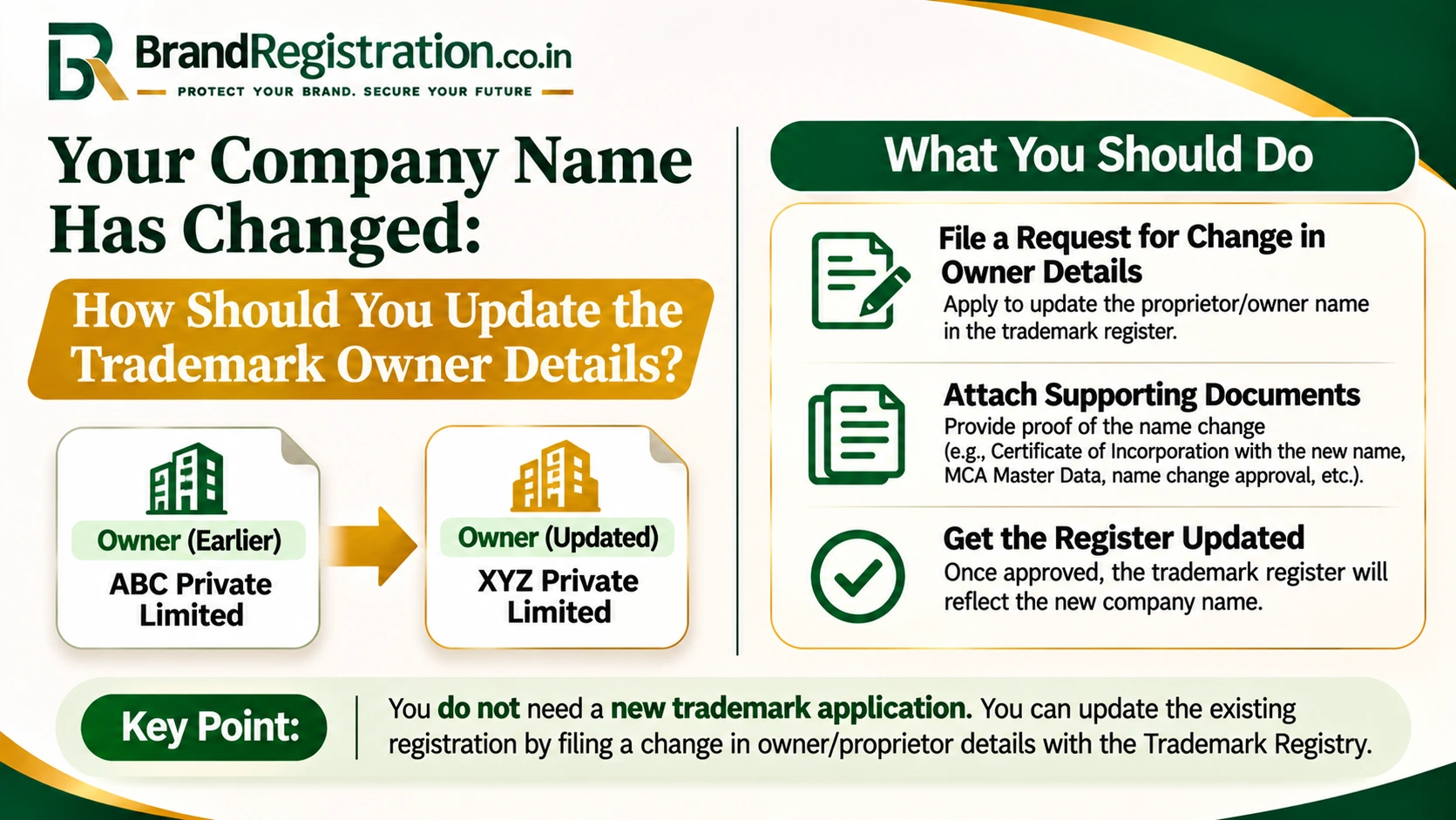
Table of Contents
For a trademark owner name change after company name change, ask the Trade Marks Registry to record the company’s new legal name against the relevant trademark record. If the same company remains the owner, a name update is generally different from an assignment to a new owner.
Start with the Registrar of Companies’ evidence of the completed name change and a list of the company’s trademark records. The route depends on whether each record is already registered or is still an application; a corporate rebrand does not update the Registry automatically.
There is no verified regulatory change or current processing benchmark in the material available for this update. The guidance below explains the existing decision and filing steps without treating an unverified fee, form label or turnaround time as a new rule.
1. Trademark owner name change after company name change: what qualifies?
1.1 The legal continuity test
The central question is whether the proprietor is still the same legal person. A company may change its registered name while continuing as the same company. Section 13 of the Companies Act, 2013 deals with changes to a company’s memorandum, including its name; the name change takes effect when the Registrar issues a fresh certificate of incorporation consequent on the change.
For a registered mark, Section 58 of the Trade Marks Act, 1999 provides for alteration of specified particulars on the register, including the name of a registered proprietor. The request concerns the identity information recorded for the owner. It does not, by itself, transfer the trademark to another company or change the wording or design of the mark.
Look at the company identifier and corporate history together with the names. A matching Corporate Identity Number can help the filing team trace the company, while the Registrar’s certificate supplies the formal evidence of the name change. The name shown on the trademark record should be capable of being linked to the name on that certificate.
1.2 When a different route is needed
If the old proprietor and the intended new proprietor are different legal persons, do not describe the transaction as a simple rename merely because both entities use the same brand. A transfer, merger or other change in ownership can require a different recordal and evidence of how title moved. The corporate transaction documents matter more than a change to marketing materials.
Illustrative example: Amber Loom Private Limited changes its legal name to Amber Loom Studios Private Limited and remains the same company. Its registered proprietor details may need a name update. If a separate company, Amber Retail Private Limited, acquires the mark, the issue is a change of owner rather than only a new name for the existing owner.
A board decision to adopt a new name is not the same thing as the completed corporate change. A business planning a rename should finish the company-law process and obtain the resulting certificate before using it as evidence of the completed change. The steps for choosing and approving the company’s name are outside this trademark recordal.
2. Which trademark records need attention?
2.1 Build a status-based inventory
A portfolio can contain registered marks, pending applications and records that need a separate status review. Before opening a filing, prepare an inventory by application or registration number rather than relying only on the list of brand names used by the marketing team. Similar-looking marks can be separate records, and the same brand can appear in different classes or formats.
Record | What to identify | Decision |
|---|---|---|
Registered trademark | Registered proprietor, number, mark and recorded particulars | Prepare the registered proprietor name update under the applicable Registry route |
Pending application | Applicant, application number and current status | Use the route applicable to an application; do not assume the registered-mark request is interchangeable |
Record with uncertain status or owner | Latest public record and supporting company history | Resolve the status or identity question before selecting the request |
For each entry, record the exact proprietor or applicant name as it appears, the current company name, the class and the mark format. Include any pending proceedings or correspondence known to the business. This gives the person submitting the request enough information to match the company evidence to the correct record.
If the status says “under examination”, the application is being examined and is not yet a registered mark. It should remain in the pending-application part of the inventory. A name update is a separate administrative issue from responding to any examination objection; do not assume one disposes of the other.
Assign a business contact to each entry. A portfolio spreadsheet is useful only if someone can supply the corporate documents, answer a Registry query and locate the filing receipt later. Add a notes column for unusual histories, such as an earlier company name that no longer appears on the latest certificate.
3. Documents required for the owner name update
The purpose of the document pack is to show who held the trademark, what the company is now called and how those names connect. The items below distinguish useful preparation from documents that may be needed only for a particular filing. The supplied official material does not establish a complete, universal attachment checklist.
Certificate of incorporation on change of name: the central corporate document showing the completed company name change. Use a clear copy and retain the original corporate record.
Trademark record details: the application or registration number and the name currently appearing on the record identify the entry to be amended. Keep a copy of the relevant record or certificate with the working file.
Earlier corporate-name evidence, where needed: if the trademark record uses a name older than the one shown immediately before the latest change, obtain the intervening records so the full identity chain can be understood.
Authority for the person acting: retain the company’s internal authorisation and, where an agent files, the applicable authority document required for that representation. These establish who can act; they are not substitutes for evidence of the rename.
Additional supporting material, where relevant: an explanation or further corporate document may help where the names, entity details or transaction history do not line up on their face.
Copy the names exactly from the underlying records, including legal suffixes and punctuation. A shortened trading name may be familiar internally but may not establish the legal owner’s identity. Keep the certificate, supporting history and trademark inventory together so that a query can be answered without reconstructing the file.
A board resolution can be useful to establish internal authority, but it should not be described as the document that makes the ROC name change effective. Likewise, identity documents, address proofs, notarisation or other formalities should not be assumed to apply to every case merely because they appear on a generic checklist. Their relevance depends on the request and the Registry’s requirements for it.
For a trademark update after ROC name change, organise any intervening documents in date order. If the company changed names more than once, a single recent certificate may not make the connection obvious to a reviewer who sees a much older proprietor name. A short chronology can make the supporting evidence easier to follow without replacing it.
4. How to submit the proprietor name change online
4.1 Submission sequence
The Trademark Registration service is relevant where the rebrand also calls for a separate application. For the existing record, use the IP India trademark e-filing system and select the request that matches the record’s status and the change sought.
Open the relevant record. Sign in through the IP India trademark e-filing gateway and identify the application or registration using its number. Compare the displayed proprietor or applicant details with the inventory.
Select the appropriate request. Choose the available option for a proprietor or applicant name alteration, as applicable. Treat a change in legal ownership as a separate issue rather than selecting a name alteration solely because the displayed name is different.
Enter the particulars. Supply the existing recorded name and the new legal name as requested. Check the legal suffix and the spelling against the corporate evidence before moving on.
Attach the supporting documents. Upload legible files that explain the change and any applicable authority to act. Follow the portal’s displayed file and signing requirements for the chosen request.
Review the generated filing and fee. Check the record number, request type, attachments and amount shown by the system. Make payment through the available official method.
Save the acknowledgement. Retain the submitted request, payment confirmation and reference number. Use that reference to follow the request and answer any subsequent Registry communication.
The supplied evidence does not include an independently verified official extract establishing the specific form number for each status. The form label displayed for the selected request is therefore an operational check at filing, not a detail to infer from a third-party summary. A registered mark and a pending application should be handled as separate entries in the work plan.
Before submission, have a second person compare the generated request with the trademark record and the certificate. The review should cover the number, old name, new name and attachments, rather than merely checking whether all fields contain text. Once submitted, the acknowledgement is evidence of filing; Registry action is a later stage.
Where an agent submits on the company’s behalf, agree who will receive portal communications and who has access to the acknowledgement. Give the agent a contact able to approve a response and provide additional corporate records. That arrangement prevents a query from sitting in a mailbox while the company assumes the filing is complete.
5. Government fees, professional charges and budgeting
Trademark name change fees are only one part of the cost. The government charge depends on the applicable request and fee schedule; professional charges, if any, depend on the service agreed with the provider. The evidence supplied does not contain a verified official fee schedule, so an exact amount cannot responsibly be quoted here.
Cost component | What to establish | Budget question |
|---|---|---|
Government filing charge | Applicable request, filing mode and unit charged under the current schedule | How many chargeable requests or records are involved? |
Professional preparation and filing | Whether the quote covers inventory review, drafting, submission and reporting | Is the price per matter, per record or for the portfolio? |
Follow-up work | Whether responses to queries, additional evidence or corrected filings are included | What work could be billed separately? |
Document preparation | Whether corporate records or representation documents need to be obtained or prepared | Are document-related costs included or passed through? |
Build the estimate as: applicable government charges for the selected requests, plus the agreed professional fee, plus any separately identified document and follow-up costs. Do not multiply a quoted amount by the number of classes or marks until the schedule and the selected filing show the applicable charging unit. A multi-record portfolio can otherwise produce a misleading budget in either direction.
Ask for an itemised quote before work starts. It should identify which records are included, whether the professional will monitor Registry communications and how a query or correction is priced. A low preparation fee that excludes all follow-up may be suitable for a straightforward portfolio, but it is a different service from one that includes handling questions through recordal.
Keep the government payment confirmation separate from the service provider’s invoice. The distinction helps with internal accounting and makes it easier to see whether a later request for payment relates to a statutory charge, additional professional work or another disbursement.
6. Processing time: what can you plan around?
6.1 Use milestones rather than a promised date
A company controls when it assembles evidence and submits a request; it does not control when the Registry reviews it. The supplied evidence contains no verified current benchmark for this type of recordal. A fixed number of days or months would therefore give the business a false planning certainty.
Preparation: depends on the number of records and the completeness of the corporate history.
Submission: produces an acknowledgement and payment trail if the filing is completed.
Registry review: may involve consideration of the request and its supporting evidence.
Query response: can require further company documents or clarification.
Completion: should be tracked through the Registry’s action and the resulting record.
Set an internal review date after filing and repeat it until the matter is resolved. The review should identify any communication requiring action, the person responsible and the next action date. An internal reminder is a management tool; it is not an official processing deadline.
For an upcoming commercial event, such as a licence negotiation or investment review, separate the planned transaction date from the expected Registry outcome. Give the transaction team the acknowledgement and corporate evidence early, rather than promising that the public record will display the new name by a particular day. If the record is updated in time, add the resulting evidence to the transaction file.
Where several requests are submitted, track each reference separately. A completed entry should not be treated as proof that every other mark has been updated. A portfolio dashboard can show “prepared”, “filed”, “query received” and “record updated” without implying that these labels are official Registry statuses.
7. Avoidable filing problems and how to correct them
7.1 Find the source of the mismatch
Most preventable problems arise when the filing tells a different identity story from the documents. The correction depends on where the discrepancy began: a typing error, incomplete evidence or an actual change in ownership are not the same problem.
Wrong record selected: compare the number, proprietor and mark with the inventory. If the wrong entry was used, establish the appropriate correction or fresh filing route rather than assuming an unrelated record will be updated.
New name entered inaccurately: compare it with the ROC certificate, including the entity suffix. Correct the request through the available Registry route if a mistake has already been submitted.
Old name does not match the evidence: trace earlier names and provide the missing link. A narrative alone may not cure an unsupported corporate history.
Ownership change presented as a rename: examine the transaction documents and use the appropriate ownership route where a different legal person became proprietor.
Illegible or incomplete attachments: replace unclear material or respond with the required evidence through the channel identified in the Registry communication.
Communication missed: identify the person monitoring the filing and diarise any response date stated in the notice. Preserve both the notice and the response.
Do not alter a company document to make it resemble the trademark record. If the record itself contains an older error, identify the correct history and seek the appropriate correction with supporting evidence.
If a query arrives, read what it asks before preparing a response. A request for clearer evidence of the name chain calls for a different response from a question about the filer’s authority. Keep the original request and each later submission together, so the reviewer and the business can follow what was supplied and why.
8. What changes after the Registry records the new name?
8.1 Reconcile the record with business documents
After Registry action, compare the resulting trademark record with the current company name and the filing request. The useful evidence is the record of the Registry’s action together with the relevant trademark details. Do not assume that the original registration certificate will automatically be replaced or rewritten in every case.
Keep the original certificate even if it bears the former name. Store it alongside the ROC name-change certificate, the request, payment acknowledgement and evidence of the Registry’s action. Together, these documents explain why an older certificate and a current company document may use different names.
Provide the reconciled record to the teams that maintain trademark licences, enforcement files and commercial diligence materials. An agreement may still refer to the former company name because that was the correct name when it was signed. The corporate evidence can help explain continuity without treating each historical document as though it were necessarily invalid.
Also review who receives trademark correspondence. A company may have changed its office, agent or address for service during the rebrand; those particulars should be assessed on their own facts and through the applicable route. Updating the proprietor’s name should not be assumed to update every contact detail.
Finally, close the entry in the portfolio tracker only when the recorded outcome has been reviewed. Note the date of the Registry action, where the evidence is stored and any outstanding related request. This gives a later buyer, licensee or internal reviewer a clear audit trail rather than a collection of unexplained receipts.
9. Name, address, agent and brand: separate decisions
9.1 Decide what actually changed
A trademark proprietor name change is one possible consequence of rebranding, not a substitute for every other update. Separate the legal owner, the owner’s contact details, the representative and the mark used in the market. Each answers a different question.
Change | Question it answers | Effect on the owner-name project |
|---|---|---|
Company legal name | What is the existing proprietor now called? | Supports an owner-name recordal where the same entity continues |
Address or address for service | Where should the relevant record show the owner or communications address? | Assess separately; do not assume it follows from the name change |
Agent or representative | Who is authorised to act or receive communications? | Review authority and representation separately |
Word mark or logo | What sign is protected or used? | Compare the registered sign with the rebranded sign; an owner update does not rewrite it |
Can a company name and brand name be different? Yes. A company can own and use a brand that does not reproduce its corporate name. The Registry’s proprietor field identifies the owner, while the trademark identifies the sign claimed in the relevant application or registration.
If the rebrand changes the logo or brand wording, assess the new sign independently. Section 59 of the Trade Marks Act deals with alteration of a registered trademark subject to limits, including that the alteration must not substantially affect its identity. A materially changed sign may call for a fresh application rather than an assumption that an owner-name recordal extends the old registration to it.
Keep two columns in the rebrand plan: “legal owner details” and “sign used with customers”. This makes it easier to spot a new logo that needs separate protection while the existing proprietor record is being updated.
10. Business names, copyright and new trademark filings
Searches for “copyright my business name” often reflect a wish to stop another business using the name as a brand. Copyright and trademarks protect different subject matter. A business should not assume that copyright registration in a creative work gives it a trademark registration for a name, or that recording a new proprietor name creates protection for a newly adopted brand.
To seek trademark protection for a business name, first identify the name or other sign to be used, the goods or services for which it will be used and the relevant applicant. Review existing marks for potential conflicts and select the appropriate goods or services before making a new application through IP India. Examination and any objections are part of the application process; filing alone is not the same as registration.
A personal name can also be proposed as a trademark, but registration is not automatic. Its suitability depends on the mark, the goods or services, possible conflicts and the applicable examination. The question “can I copyright my name?” should not be treated as a shortcut to an exclusive trademark right in that name.
For a company that has merely changed its legal name, a fresh trademark application is a separate decision from correcting the existing proprietor details. Consider it where the business has adopted a new sign or wants protection for a different use. Keep the old registration in the portfolio review if the business still relies on it; a new filing does not itself resolve the old record’s proprietor details.
11. Your next three actions
Classify the change: establish whether the same company continues or a different entity acquired the trademark, and separate registered marks from pending applications.
Assemble the file: match each record to the ROC name-change evidence, add any earlier corporate-name documents and allocate responsibility for correspondence.
Plan submission: identify the applicable online request and current government charge for each matter, decide whether professional assistance is needed, and track the request through Registry action.
Begin the process online via the official government portal, or engage Brand Registration for end-to-end assistance
Frequently Asked Questions
Does a company rename require a trademark assignment?
Generally, no. If the same company continues as proprietor and only its legal name changes, the issue is an update to its recorded name. A transfer to a different legal person requires a separate ownership analysis.
What evidence links the old company name to the new one?
The certificate of incorporation issued on change of name is central evidence. If the trademark record shows an earlier name that is not directly linked by the latest certificate, intervening corporate records may also be needed.
Are pending applications handled in the same way as registered marks?
Do not assume so. Identify each record’s status and select the IP India request applicable to an application or a registered mark, as appropriate.
Does filing a name update immediately change the public trademark record?
A filing acknowledgement shows that a request was submitted. Registry review and the resulting update are separate stages, so track the request until the recorded outcome is available.
Can a company name and brand name be different?
Yes. The company’s legal name identifies the owner, while its brand name identifies the sign it uses for goods or services. The two names do not have to be identical.
Does an owner name update protect a redesigned logo?
No. Updating the proprietor’s name does not rewrite the registered mark. A redesigned logo should be assessed separately, including whether a new application is appropriate.
What does under examination mean in trademark status?
It means the application is being examined and is not yet a registered mark. Any examination issues remain separate from a request to update the applicant’s name.
Can I copyright or trademark my business name?
Copyright and trademark protection are different. To seek trademark protection for a business name, assess the proposed sign, the goods or services and potential conflicts, then apply through IP India. Registration is not automatic.