Trademark Application Pending for Examination for Months? What to Check Before Following Up
23 November 2026
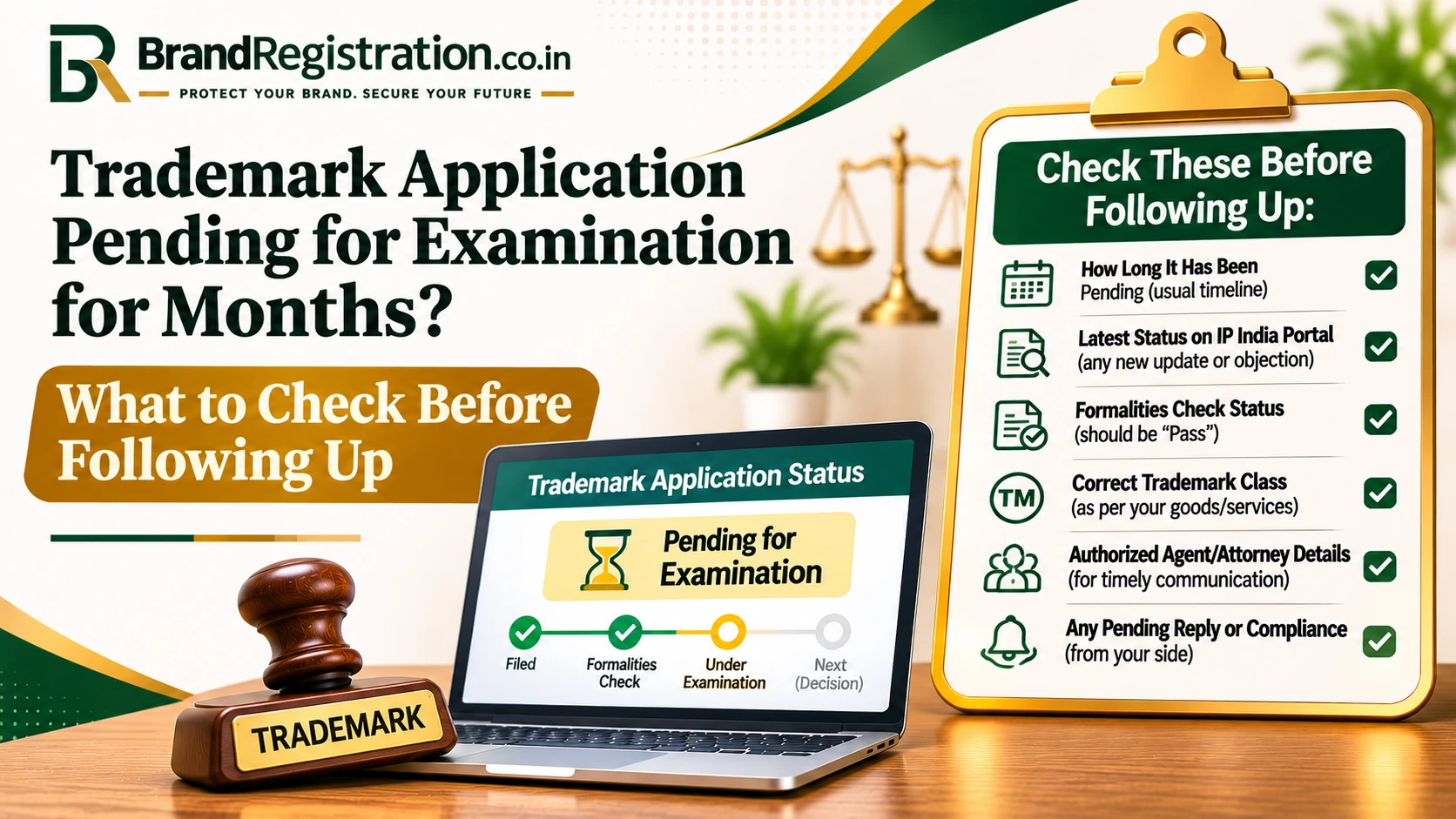
Table of Contents
If your trademark application is pending for examination for months, first open its full record on the IP India Trade Marks Registry portal and check for reports, notices and recent correspondence. If no action is recorded, prepare a focused enquiry; if faster processing matters, consider whether a paid request for expedited processing on Form TM-M is suitable.
An unchanged status does not, by itself, establish that the application has been rejected or that the Registry has missed a legally prescribed deadline. The useful question is whether your file is genuinely awaiting examination or whether a document on the record calls for a different response.
This guide covers an Indian trademark application that has already been filed. It helps brand owners separate an ordinary status check from a formal request, prepare a follow-up and budget for the decisions that may come next.
1. What does trademark application pending for examination mean?
1.1 Read the label alongside the record
A “Marked for Exam” status generally indicates that the application has been directed towards substantive examination. At that stage, the Registry considers whether the mark can proceed under the Trade Marks Act, 1999, including whether there are grounds for objection.
The status is a description of the application’s stage, not a promise that examination will finish by a particular date. It is also not the same as registration. A pending application may still face objections or other proceedings before it can be registered.
For a trademark application under examination for months, the status field is only the starting point. Look at the application particulars and any available examination reports, notices, orders and correspondence. A document’s date and contents can matter more than a short label displayed on a search screen.
A timestamp in your own records helps distinguish “I have just noticed the status” from “I have seen the same status at successive checks.” Neither observation identifies your position in a trademark registry examination queue. Treat a queue listing, if available, as information to read in its own context rather than a guaranteed appointment.
1.2 When a different status changes the job
What appears on the record | What to do with it |
|---|---|
Marked for Exam or examination pending | Review the full file for communications, then decide whether a targeted enquiry or an expedition request is worthwhile. |
Formalities Chk Fail | Identify the procedural deficiency stated in the record and address that issue through the applicable channel; a general examination-delay enquiry does not cure it. |
Objected or an examination report | Read the report and its communication details. The task is to deal with the objections, rather than ask when an initial report will be issued. |
Ready for Show Cause Hearing | Review the hearing-related record and prepare for the issues and date communicated by the Registry. |
Advertised or opposed | Move from examination tracking to publication monitoring or opposition proceedings, as applicable. |
A show cause hearing is an opportunity to address the Registrar on concerns affecting acceptance of the application. “Ready for Show Cause Hearing” is not itself a hearing date or a refusal. The notice and record should tell you what has been scheduled and what issue remains to be addressed.
2. Who can follow up, and when is expedition relevant?
2.1 Ordinary status enquiries
The applicant named in the filing has the clearest interest in asking about its progress. An authorised trademark agent or legal representative can also act within the scope of their authority. A public status search, by contrast, is an information-gathering exercise and does not itself change the application.
If an outside professional filed the mark, agree who will handle communications before opening a parallel enquiry. The business owner should know the application number, the applicant’s recorded name and the contact route used for the filing. An enquiry is more useful when it refers to the actual applicant rather than only a trading name customers recognise.
The company name and brand name can be different. For example, a company may own a product brand that does not contain its corporate name. The record should nevertheless identify the correct legal applicant; ownership of a company name alone is not the same thing as registration of every brand the company uses.
2.2 The expedited-processing choice
Expedited processing is an option for an applicant who wants to seek faster handling through the prescribed procedure, rather than merely ask for an update. Rule 34 of the Trade Marks Rules, 2017 provides for a request on Form TM-M with the prescribed fee. The request concerns the existing application; it is not a substitute for filing a trademark application.
Consider the commercial reason for paying for expedition. A launch, licensing negotiation or planned investment may make earlier examination valuable, but faster processing does not guarantee acceptance, eliminate objections or prevent a third party from opposing an advertised mark. If the file has already moved to another stage, assess that stage before assuming an examination-focused request is the appropriate step.
An individual does not need to form a company simply to apply for a trademark. The applicant should be the person or legal entity seeking the mark. For someone who has not yet filed a business name, the starting task is to assess the mark and the relevant goods or services, then file the appropriate application; this delay guide begins after that filing has been made.
3. What to gather before contacting the Registry
For a routine enquiry, assemble a concise working file rather than resubmitting every original filing attachment. The following items have different purposes; the list is practical preparation, not a claim that every item is a statutory attachment to every enquiry.
Application number: identifies the exact Registry record, especially where a business has several marks or classes.
Filing acknowledgement or application copy: shows the recorded applicant, mark, filing particulars and contact information to compare with the live record.
Current status record: a dated copy or screenshot preserves what you saw when preparing the enquiry.
Reports, notices and correspondence available on the file: establish whether the Registry has already communicated an issue and what it concerns.
Prior enquiry and response records: help the recipient trace an earlier request and prevent the same question being sent repeatedly without context.
Representative details and authority, where relevant: establish who is handling the matter and whether a representative has the necessary authorisation for the action proposed.
3.1 Core record
Keep the mark representation and the goods or services description with the application copy. They help distinguish an application for a word from one for a logo, and one class from another. They also let an adviser assess whether the enquiry concerns the application the owner actually intended to pursue.
Record the date on which you viewed each document, as well as the date shown on it. Those are different facts: a document may have been issued or communicated before the day an owner first noticed it. Preserve the original electronic record where available instead of relying only on a summary written from memory.
3.2 Additional material for a representative or a specific request
If you are asking a new professional to take over, provide the prior representative’s details and the correspondence history. The form of authority or change of representation needed depends on the proposed action and existing record; it should not be assumed that a simple status search requires the same paperwork as acting for the applicant.
For a formal TM-M request, use the applicable portal instructions for the request type, including any payment and attachment requirements. A short business explanation of why timing matters can help the applicant make the decision internally, but this article does not treat a particular supporting letter as universally mandatory.
4. How to check the record and make a focused follow-up
The sequence below keeps preparation, submission and post-submission tracking separate. The official source is the Trade Marks Registry’s application-status facility on IP India; the application number is the starting point for finding your file.
Prepare: locate the application number and open the IP India Trade Marks Registry application-status facility.
Search the relevant application and read the complete record available, not just the short result label.
Identify the actual question: note the current stage, the most recent relevant document and the period over which you have observed no change.
Decide whether you are seeking information about progress or considering a formal request for expedited processing.
Choose the channel: use the current contact or grievance route published by IP India for an enquiry.
If proceeding with expedited processing, use the Trade Marks e-filing facility and the applicable Form TM-M request rather than presenting an ordinary message as a paid formal request.
Submit a specific request: identify the application and applicant, state the status and ask for the information or action you seek.
Retain the submission acknowledgement and any payment receipt generated for a formal filing.
Track the response: save the reference number, date and channel used.
Revisit the official record for a response or a new Registry communication, and route any substantive notice to the person responsible for responding.
4.1 Prepare
Make the question narrow enough for the recipient to answer. “Please let me know whether any action or communication is outstanding on application number [your number]” is more informative than “My trademark is stuck.” The bracketed phrase here describes the information to insert in your own message; it is not a Registry form requirement.
Include a concise chronology if you have one: the filing date, the status observed and the dates of earlier enquiries. Do not infer a Registry error simply from the number of months elapsed. A factual chronology gives the recipient something to locate without asking them to accept an unsupported conclusion.
4.2 Submit
An enquiry asks for information or attention to a concern; a grievance expresses a problem with the handling of the matter. Neither should be described as automatically moving the application to the front of a queue. Select the available official route that fits the issue and keep the message tied to one application unless the channel specifically permits a grouped request.
A TM-M request is a different transaction. Follow the e-filing options and instructions for expedited processing, review the details before authorising payment and retain the acknowledgement. The relevant Registry process, rather than the wording of a general email, determines how that formal request is handled.
4.3 Track the response
Assign one person responsibility for watching the application and receiving messages from the filing representative. A useful follow-up log contains the application number, submission date, reference, question asked, response and next action. This prevents a new team member from starting over when the person who filed the mark leaves the business.
If the response points to a report or procedural issue, deal with that issue on its own terms. If there is no useful response, a later enquiry can refer to the earlier reference and ask a more precise question. Repeated messages sent on the same day are unlikely to add information to the file.
5. Government fees and professional charges
The cost depends on the action selected. An ordinary enquiry, a formal request for expedited processing and professional representation are not interchangeable line items. Current official charges should be taken from the applicable Trade Marks Rules fee schedule and the live e-filing transaction, rather than inferred from a quote for trademark registration.
Action or cost | What to establish before spending |
|---|---|
Ordinary status enquiry | Identify the official channel and whether the proposed communication is an enquiry rather than a formal paid filing. |
TM-M expedited-processing request | Identify the prescribed government fee for the applicant and filing mode in the applicable schedule and transaction. |
Professional review or follow-up | Ask for the professional charge separately from any government payment, including the scope of work and taxes, if applicable. |
Later objection, hearing or opposition work | Ask whether it is included or will be quoted separately; these stages may require work beyond monitoring an examination delay. |
5.1 Budget by action
A registration-service invoice may combine the original filing fee with professional charges. It does not necessarily include a later expedition request or a response to an objection. Ask for a written breakdown before authorising an additional transaction, particularly if several applications are involved.
Expedition is a spending decision, not an assurance of registration by a commercial deadline. Compare its cost with the value of receiving Registry action sooner and with other work the application may still require. An applicant with no immediate commercial deadline may reasonably choose monitoring and a targeted enquiry instead.
5.2 Scope an external engagement
When requesting help, specify whether you want a one-time review, preparation of an enquiry, a formal filing or continuing management. Ask who will receive Registry communications and whether the quote includes reviewing future notices. A low initial quote can leave a business with an unexpected later bill if the scope stops at filing.
Brand Registration’s Trademark Registration service is relevant if you want assistance with the application rather than managing the record alone. Agree the work and charges before instructing a service provider; professional fees are separate from amounts payable to the government.
6. How long can examination take?
6.1 Milestones are not interchangeable
There is no verified current examination-duration benchmark in the material used for this guide. A specific number of months would therefore give a false sense of certainty. The time already spent waiting is useful context for an enquiry, but it does not by itself prove that the application should have been examined by now.
Examination is only one milestone. An application may then be accepted, receive objections, require a hearing or proceed to advertisement. Where an application is advertised, Section 21 of the Trade Marks Act provides a four-month period from advertisement for a notice of opposition. That statutory period is distinct from the unverified waiting time before examination.
If an examination report is communicated, Rule 33 of the Trade Marks Rules provides for a response within one month of receipt of the communication. The actual document and communication history matter when calculating a deadline. Do not use the date on which you happened to look at the portal as a substitute for establishing when the report was received.
Registry workload and the issues raised in an individual application can affect how long the route to registration takes. An expedited request may alter how processing is sought, but it does not turn the remaining stages into a fixed delivery schedule. A commercial plan should allow for the possibility of objections or opposition even where the initial examination occurs sooner.
6.2 A useful monitoring record
Maintain a dated history of status checks and communications. Set an internal review date that suits the business’s risk and launch plans; that is a management reminder, not an official Registry deadline. If a notice appears, replace the general reminder with the deadline and action relevant to that notice.
For a portfolio, track applications separately. A word mark and a logo, or applications in different classes, have their own records even when they protect the same commercial brand. One application changing status does not establish that another has reached the same stage.
7. Mistakes that make a delay harder to resolve
7.1 Follow-up errors
Chasing the wrong application: a business may have multiple filings with similar names. Consequence: the enquiry yields an answer about the wrong record. Correction: match the number, applicant, mark and class before submission.
Assuming the label is the whole file: a report or notice may require attention even when the owner is focused on the summary status. Consequence: the wrong request is sent. Correction: review the available documents and communication history before choosing the action.
Treating an enquiry as a formal request: a message asking for speed is not the same as a TM-M transaction. Consequence: the applicant may believe expedition has been requested when it has not. Correction: decide which action is wanted and retain evidence of the appropriate submission.
Sending inconsistent parallel instructions: an owner and agent may contact the Registry separately without sharing responses. Consequence: the history becomes difficult to reconstruct. Correction: designate a lead contact and share acknowledgements and replies.
Filing a new application merely because the old one appears slow: a fresh filing is a separate application, not a repair to the existing record. Consequence: the business incurs another filing and must assess the new application on its own terms. Correction: identify the issue with the existing file before deciding whether a fresh filing serves a separate purpose.
7.2 Substantive objections need their own response
Some applications face objections because the mark lacks distinctiveness under Section 9 of the Trade Marks Act or because of a conflict with an earlier mark under Section 11. Those are substantive issues, not proof that the enquiry was poorly drafted. The response must address the grounds actually raised in the report.
A missed or incomplete response can have serious consequences for an application. If a report, hearing notice or adverse order appears, preserve the document and its communication details and obtain targeted help where the issue or deadline is unclear. A general request for an update does not answer an examination objection.
Do not treat a request for expedited processing as a way to cure a defect in the underlying application. Speed and registrability are separate questions; an examiner can still raise an objection that must be addressed.
8. What changes after registration?
8.1 Keep the certificate and renewal date
Once registered, preserve the registration certificate alongside the application history and record the registered proprietor, mark, class and covered goods or services. Under Section 25 of the Trade Marks Act, registration is for ten years and is renewable. Use the date reflected in the registration record to diary the applicable renewal date and keep the owner’s contact arrangements current.
Section 23 connects the registration date with the application date, subject to the Act. This is why a business should not assume that its renewal diary starts on the day it downloads a certificate. Renewal is a later maintenance task, separate from the examination enquiry addressed in this guide.
8.2 Protect the registered scope
Brand registration protects the mark as registered in relation to the covered goods or services; it should not be treated as automatic protection for every product, logo variation or future business line. Keep an internal record of meaningful brand changes and assess whether additional protection is needed when the business expands.
Monitor for relevant third-party use and preserve records of the business’s own use. Registration provides a foundation for enforcement, but the owner still has to identify potential problems and decide how to respond. The registered-trademark symbol should be used only when its use accurately reflects the mark’s registration position.
9. Choose your next three actions
Open the official record for each application and identify the latest document and responsible contact. If a report or notice exists, put its required response ahead of a general delay enquiry.
If the file is still awaiting examination and no issue is apparent, prepare a concise enquiry with the application number and chronology. If speed has a clear commercial value, assess the separate TM-M option and its cost.
Assign one person to retain acknowledgements, watch for Registry communications and manage the next deadline. Seek targeted assistance if the record raises a substantive objection, representation issue or decision you cannot resolve internally.
Begin the process online via the official government portal, or engage Brand Registration for end-to-end assistance
Frequently Asked Questions
Does Marked for Exam mean my trademark has been rejected?
No. It generally indicates that the application has been directed towards examination. Read the complete IP India application record for any report, notice or other communication before deciding what to do.
Can I ask the Registry about an application that has not changed for months?
Yes. Identify the application, describe the status and give a concise chronology through the current official contact or grievance route. An enquiry asks for information; it does not guarantee an earlier examination.
Can I request expedited processing using Form TM-M?
Rule 34 of the Trade Marks Rules, 2017 provides for a request for expedited processing on Form TM-M with the prescribed fee. Review the current e-filing instructions and assess whether the request is suitable for the application's stage.
What should I do if an examination report appears?
Read the grounds in the report and establish its communication history. Rule 33 provides for a response within one month of receipt of the communication. A general enquiry about delay is not a substitute for a response to the report.
What is a show cause hearing in trademark proceedings?
It is an opportunity to address the Registrar on concerns affecting acceptance of the application. A status indicating that the matter is ready for a hearing is not itself a hearing date or a refusal; review the Registry's notice and record.
Can a company name and brand name be different?
Yes. A company can use a brand name different from its corporate name. The trademark application should identify the correct legal applicant, and having a company name does not automatically register every brand the company uses.
How can I trademark my business name in India?
Assess the name and the goods or services for which protection is sought, then file the appropriate trademark application with the Trade Marks Registry through the IP India system. An individual can apply without first forming a company.
Does following up change my trademark filing date?
An ordinary status enquiry does not itself change the filing date. It concerns the existing record. A fresh application is a separate filing and should not be assumed to inherit the earlier application's date.